

Since May 2025, Octopusbot has predicted declining Bulgarian corn production, a trend that official agencies are only reflecting now. Octopusbot’s AI models accurately captured and quantified the impact of extreme summer heat, prolonged drought, and depleted soil moisture on yields. Farmers had also reduced planted area after several consecutive years of low production, adding further pressure to output. As a result, these key drivers point to a significantly smaller crop than projected by the Ministry of Agriculture and the European Commission.
Octopusbot’s Latest Estimate Highlights Divergence from Official Forecasts
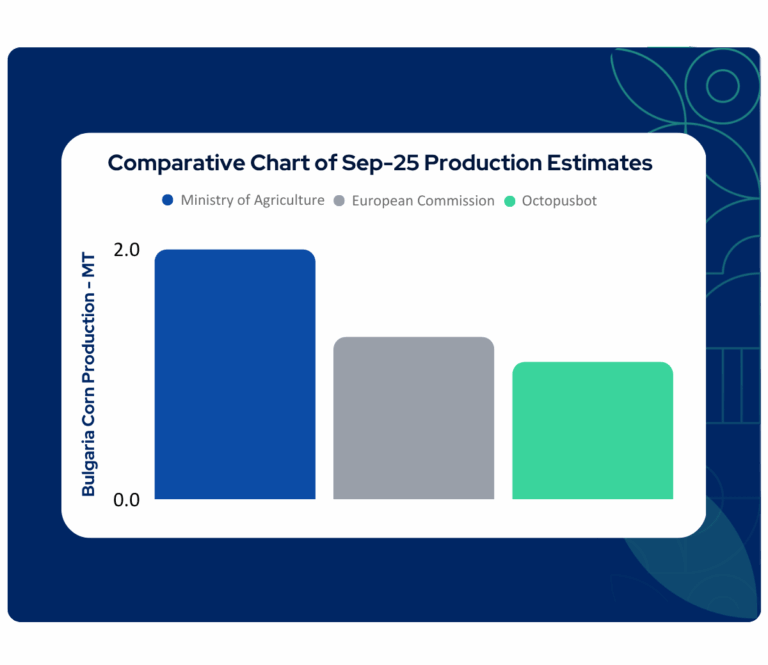
For the 2025/26 season, official agency estimates for Bulgarian corn remain high. The Ministry of Agriculture estimates production at 2.0 MT, while the European Commission’s estimate is 1.3 MT. Octopusbot’s estimate is 41% lower than the Ministry’s and 8.3% below the European Commission’s, reflecting the impact of reduced planted area and record dryness.
Octopusbot has continued to predict a significant decline in Bulgaria’s corn production since May 2025, giving market participants a timely and more accurate view of production risks, while European agencies have yet to fully reflect these conditions.
Extreme Heat During Critical Growth Stages
Bulgaria’s corn crop in 2025/26 was hit by an extended period of extreme heat during the crop’s critical growth stages. From late July into August, maximum temperatures exceeded 35 °C for 25 consecutive days, one of the most severe heatwaves since 1950. This coincided with flowering and early grain fill, accelerating maturity, reducing biomass, and limiting pollination efficiency. With soil moisture already depleted by significantly below-median July rainfall, the heat further constrained kernel development and yield potential.
The 2025 season marks the fourth consecutive year of extreme heat events in Bulgaria, reinforcing the structural challenges facing corn production. These conditions have not only reduced yields but also contributed to the steady decline in planted area as farmers adapt cropping choices in response to recurring heat and soil moisture deficits.
Octopusbot Corn Production Estimate
The latest estimate for Bulgarian corn production in the 2025/26 season has been reduced compared to the previous estimate by Octopusbot, largely driven by adverse weather conditions. The revision reflects the driest July and August months of the last 24 years, along with significantly below median rainfall during the crop’s critical planting and mid-season stages.
The key drivers impacting Bulgarian corn production in the 2025/26 season are:
- Planted Area: Corn planted area reduced 10.5% year-on-year and is 17.1% lower than the five-year average.
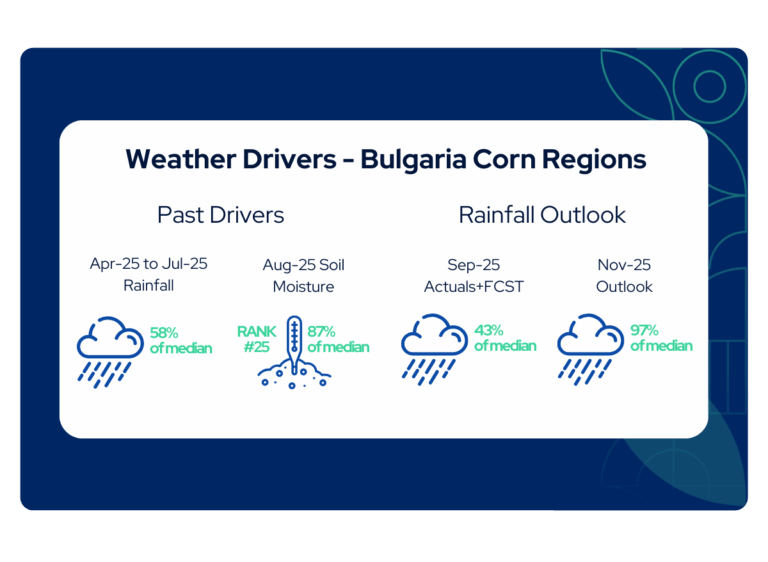
- Precipitation: Rainfall from April to July 2025 was 58% of the median.
- Soil Moisture: Soil moisture ranked at the lowest level (#25) of the last 25 years. August soil moisture recorded severe deficits at 87% of the median.
- Outlook: September 2025 rainfall actuals-plus-forecast indicate 43% of the median, while November 2025 is expected to be 92% of the median.
Impact on Yields
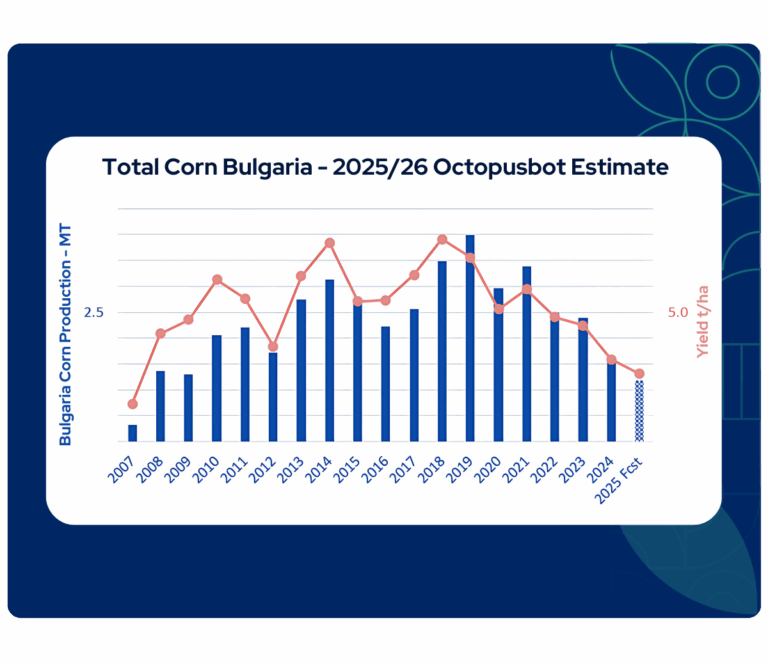
Yield estimates for Bulgarian corn in the 2025/26 season show a wide gap between official agencies and Octopusbot. The European Commission reduced its yield estimate in the same month, lowering it from 3.24 t/ha to 3.08 t/ha in its latest September release. Octopusbot’s latest estimate stands lower at 2.62 t/ha, which is 15% below the European Commission’s figure.
Relative to historical benchmarks, Octopusbot’s September yield estimate is 17.5% lower than last year and 44.6% below the five-year average, marking the lowest yield since 2008.
Octopusbot’s Forecast Accuracy
The gap between official agency estimates and Octopusbot’s forecasts highlights the value of data-driven modelling in capturing field conditions earlier than traditional forecasts and quantifying their impact with accuracy. This enables farmers, agribusinesses, brokers, and traders to maximize profits, mitigate risks with confidence, make smarter decisions, and stay informed with regional and global coverage.
Octopusbot’s track record in Europe reinforces this capability. In April 2024, Octopusbot predicted the season’s production trend within 95% accuracy range, 8 months before the final estimate and 4 months before USDA, with a difference of 1% on the final estimate.
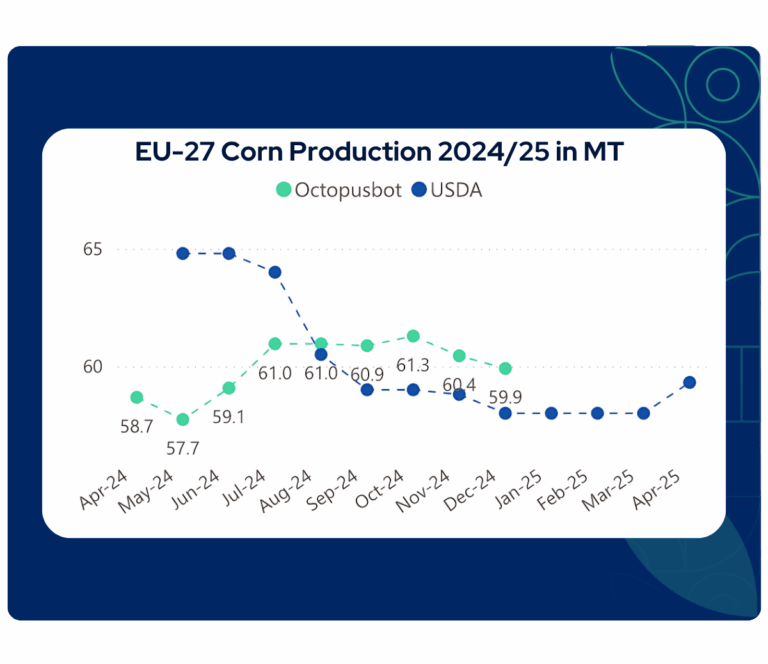
For Bulgaria, Octopusbot has estimated a declining corn production trend since May 2025, ahead of the Ministry of Agriculture and the European Commission. Octopusbot’s hundreds of interconnected models, integrating weather parameters and regional crop conditions, captured the impact of record dry conditions, low rainfall during critical growth stages, and reduced planted area, at a time when official agencies maintained higher estimates.
Comments are closed