

As China’s 2025/26 harvest season progresses, Octopusbot’s AI-driven models indicate lower corn production estimates compared to last season. The models also show figures significantly below the official estimates reported by China’s National Bureau of Statistics (NBS), reflecting late-season weather conditions not yet captured in government assessments.
During September and October 2025, excessive rainfall across key producing provinces has disrupted corn harvest and reduced yields to their lowest levels since 2018. The same rainfall is also delaying wheat planting for the upcoming season, creating a challenging start to China’s next grain cycle.
In this analysis, we explore how heavy harvest-season rainfall has affected China’s corn production, the key drivers behind the lower yield outlook, and the spillover effects on wheat planting as the country transitions into the 2026 growing season.
Excessive Harvest Rains Disrupt China’s Corn Belt and Supply Chain
In October 2025, 58% of China’s corn-growing regions recorded significantly high rainfall, exceeding 200% of the median, marking one of the wettest harvest periods in recent decades.
Octopusbot’s AI-driven forecasts indicate widespread disruption across the corn belt with October 2025 harvest rains:
- North China (23% of corn area) received 247% of median rainfall.
- East China, which represents 13% of the area, experienced an extreme 536%, the highest among all regions.
- South-Central China recorded 289%, while Northwest China received 207% of the median rainfall.
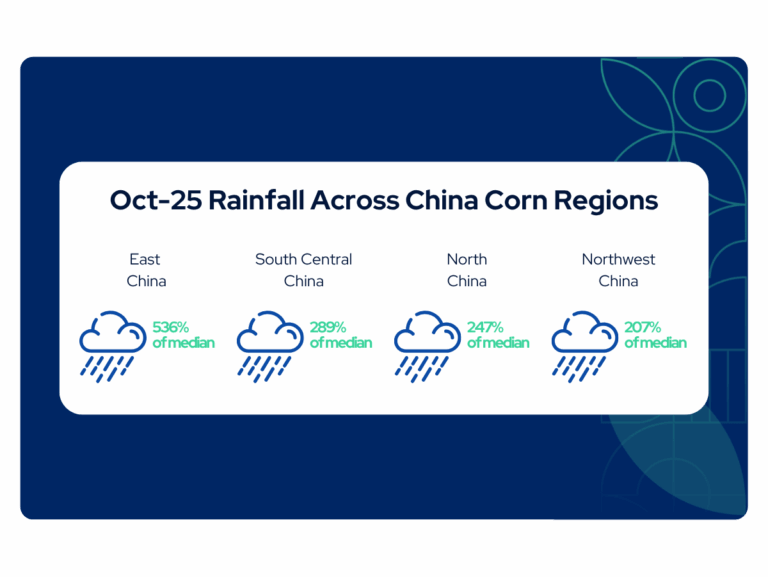
In October 2025, major corn-producing provinces such as Shandong and Henan recorded rainfall at 703% and 360% of the median respectively. This is reinforced by the National Climate Center, which reported that these provinces experienced their heaviest and longest rainy season in 6 decades, severely disrupting harvest and post-harvest handling. Prolonged rainfall caused waterlogging, grain sprouting, and drying delays, forcing many farmers to sell newly harvested corn early to prevent further losses. This rapid selling pressure has driven local corn prices in Henan down by around 3% in October 2025.
Most of China’s corn is used for animal feed and ethanol production, and the country’s increasing reliance on domestic output has left it more exposed to such weather shocks. With imports declining sharply, disruptions in the corn harvest have created logistical and quality challenges across the supply chain.
Octopusbot China Corn Estimate
Octopusbot’s latest estimates indicate that China’s 2025/26 corn production is lower than last season. While Octopusbot’s estimate was revised upward from October to November 2025 due to lower-than-forecast October rainfall, overall harvest-period rainfall was still significantly above-median (157% in September; 215% in October), placing Octopusbot’s production estimate 5.7% below China’s NBS estimate (represented by USDA figures in the chart below).
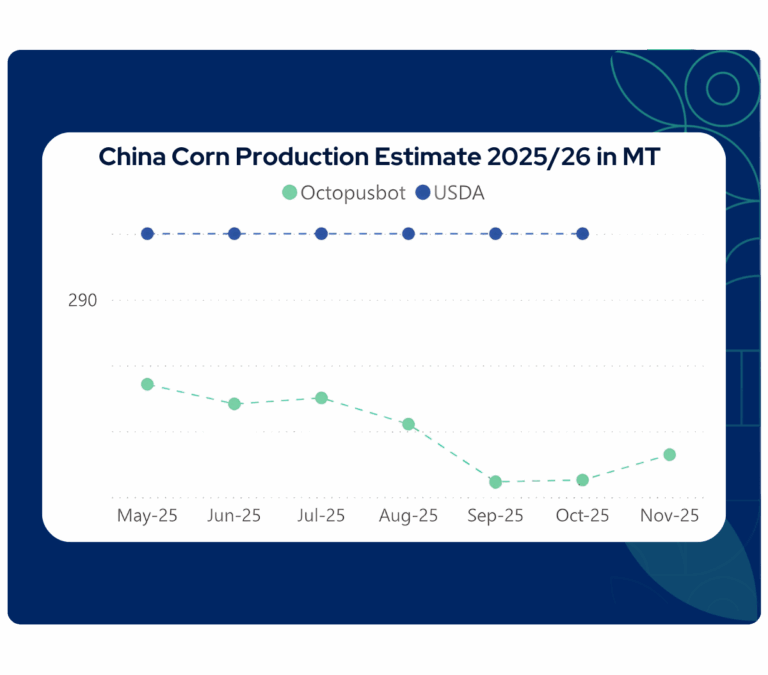
Octopusbot’s proprietary technology combines hundreds of weather parameters with provincial-level historical yield data to accurately forecast seasonal outcomes. These models capture the effects of significantly wet harvest conditions that are not yet fully reflected in official estimates.
The key drivers impacting corn production this season include:
- Precipitation: October 2025 recorded slightly lower-than-forecast rainfall (215% vs. 225% forecast) but remained significantly high. Northeast China recorded below-median rainfall (62% of the median), while all other key regions recorded significantly above-median levels.
- Soil Moisture: National soil moisture was 111% of the long-term median, ranking #11 of the last 24 years. Most regions remained above median, except the Northeast, which was below median. East and South-Central China ranked #3 of the last 25 years.
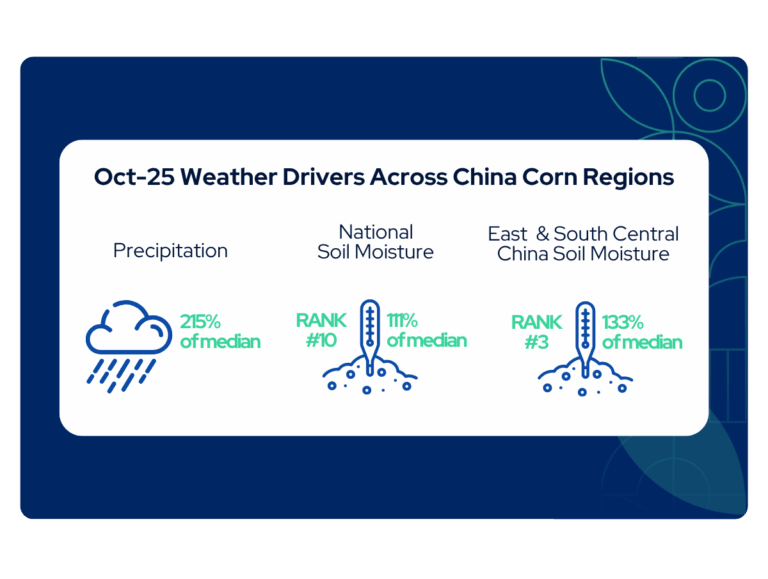
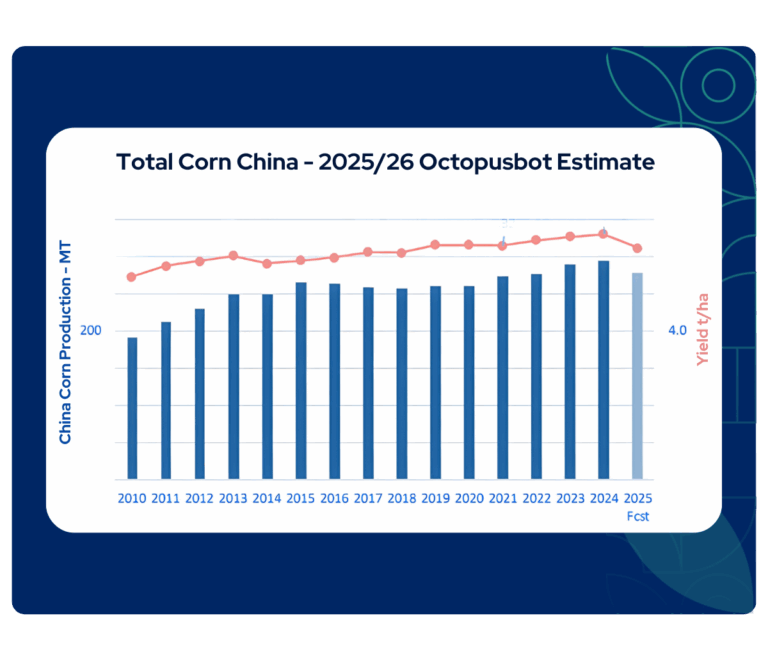
Prevailing weather and soil-moisture conditions have led to lower yields, estimated to be below last season and the lowest since 2018. Early-season soil-moisture deficits were partially offset by June–July rainfall, but excessive precipitation during harvest impacted yields, particularly across major producing provinces such as Jilin and Hebei.
Excessive Rainfall Delays Wheat Planting for the 2026 Season
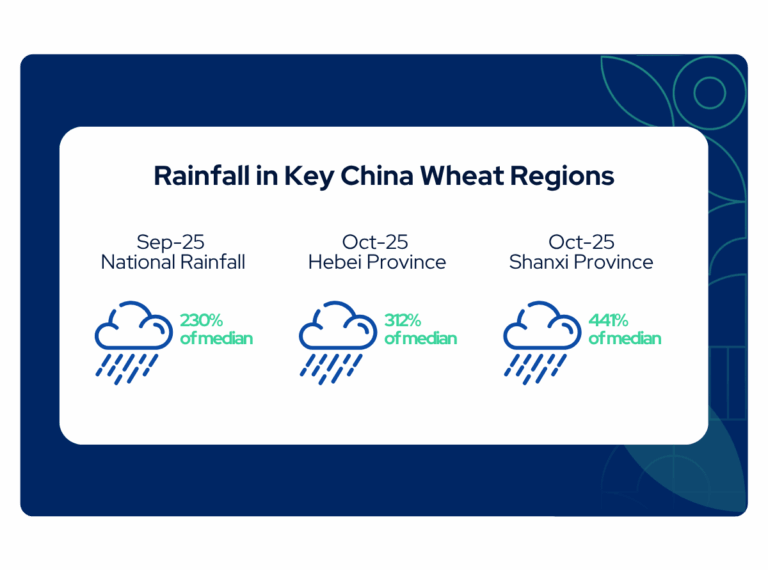
Octopusbot’s models indicate that major wheat-producing regions in China recorded significantly high rainfall during September 2025, affecting the start of planting for the next season. East China, which accounts for 39% of the national wheat area, received 239% of median rainfall, while South-Central China (28% of wheat area) recorded 300%. These regions represent the core of China’s wheat belt, and persistent wet conditions have delayed planting operations.
In October 2025, excessive rainfall continued across the northern provinces, with Hebei and Shanxi recording 312% and 441% of median rainfall, respectively. According to the Ministry of Agriculture and Rural Affairs, national wheat planting progress remained well behind the long-term average through mid-October, as saturated soils and prolonged wet conditions hindered machinery movement and seedbed preparation.
The delayed start to planting raises the risk of reduced planted areas and uneven crop emergence heading into the 2026 season, particularly if conditions remain wetter than average through November.
Octopusbot’s Forecast Accuracy
Octopusbot’s 2025/26 forecast provides a data-grounded assessment of China’s corn production outlook, indicating lower production compared to China’s NBS estimates. The difference reflects Octopusbot’s incorporation of excessive rainfall and high soil-moisture impacts during the harvest period, which have not yet been fully captured in government figures.
Over recent seasons, Octopusbot’s AI forecasts have consistently identified production trends ahead of official revisions, helping market participants interpret changing crop conditions and anticipate shifts in supply outlook with greater accuracy and lead time.
In April 2024, Octopusbot predicted the season’s production trend within 95% accuracy range, 7 months before the final estimate and 1 month before USDA, with a difference of 3.6% on the final estimate.
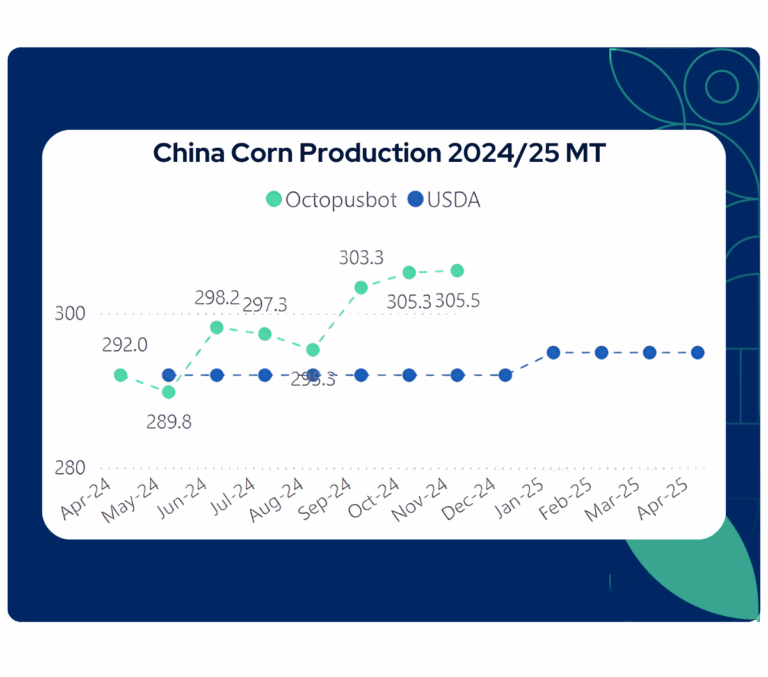
The increase in Octopusbot’s estimates toward the end of the season reflected improved soil moisture from rank #10 to #5 of the last 24 years due to optimal near-median rainfall in August 2024 supporting stronger yields. Octopusbot captured real in-season developments ahead of official figures, delivering early, data-driven insights that reflect true production outcomes.
 For full, detailed AI forecasts on China wheat, corn & more:
Comments are closed