

Extreme weather events are already shaping the outlook for major wheat crops in the new season 2026/27. Across key producing regions, disruptions during sowing and early growth stages are negatively impacting yields.
In China, excessively wet conditions during sowing led to delayed winter wheat emergence. This was followed by persistent soil moisture deficits across major producing provinces, which are now negatively impacting yields and putting downward pressure on production.
In India, unseasonal and uneven rainfall during critical growth stages, combined with a wet harvest outlook, is also negatively impacting yields despite higher planted area.
This blog examines how Octopusbot captures these impacts through a data-driven approach, combining rainfall patterns, soil moisture trends, satellite indicators, and yield implications to quantify production shifts well ahead of traditional agencies.
China Wheat Sees a Challenging Start to the Season, Satellite Data Confirms
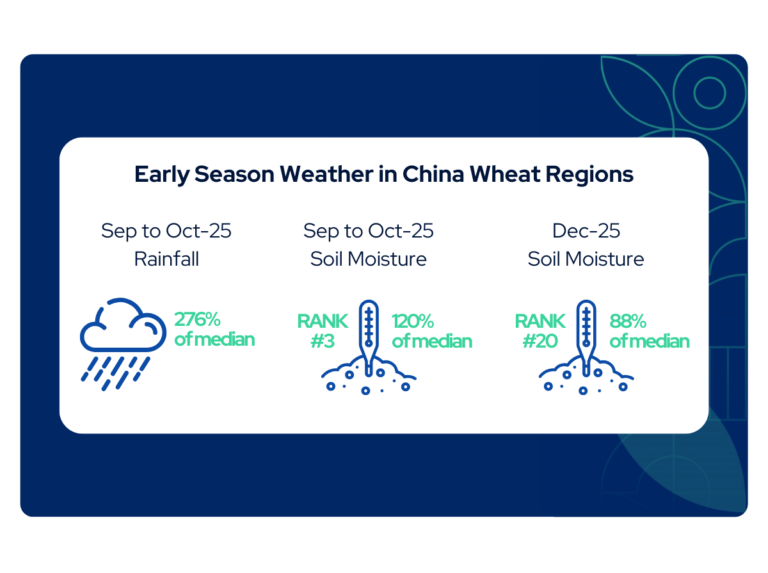
The sowing period (September–October 2025) recorded extreme precipitation across China’s major wheat regions, reaching 276% of the median overall. Such excessive rainfall during this critical window likely disrupted sowing operations and resulted in delayed winter wheat emergence across key producing provinces.
However, moisture conditions shifted sharply by December. Soil moisture rose to record levels during September–October (around 120% of the median), before declining to below-median levels in December (88% of the median). East and South-Central China, which account for approximately 69% of total wheat area, ranked #23 driest of the last 26 years in December, reflecting severe soil moisture deficits following the excessively wet sowing period.
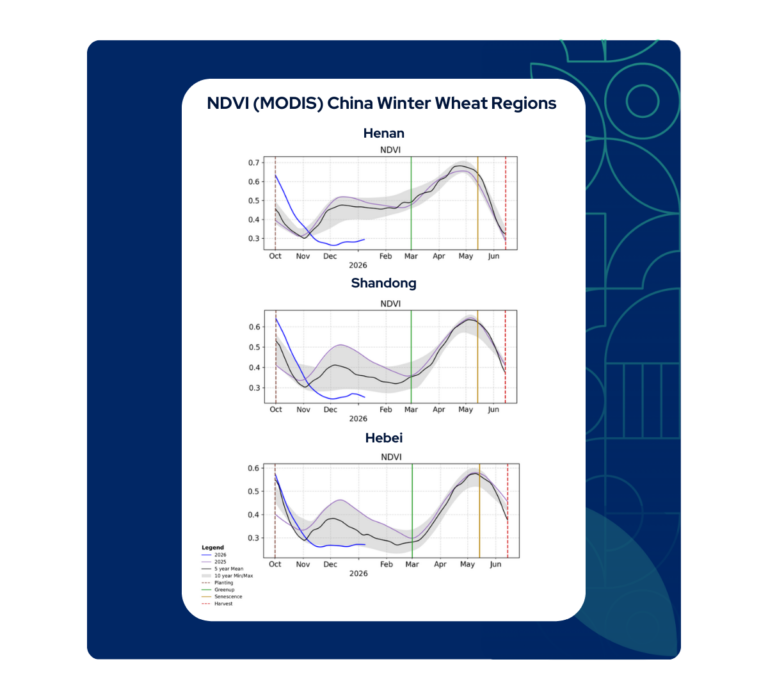
Satellite indicators confirm the impact of this volatility. The chart illustrates latest MODIS NDVI readings for three of China’s largest wheat-producing provinces, Henan (24% of national wheat area), Shandong (17%), and Hebei (10%), where the 2026 season (blue line) is tracking well below both the 2025 season and the five-year average, indicating delayed winter wheat emergence.
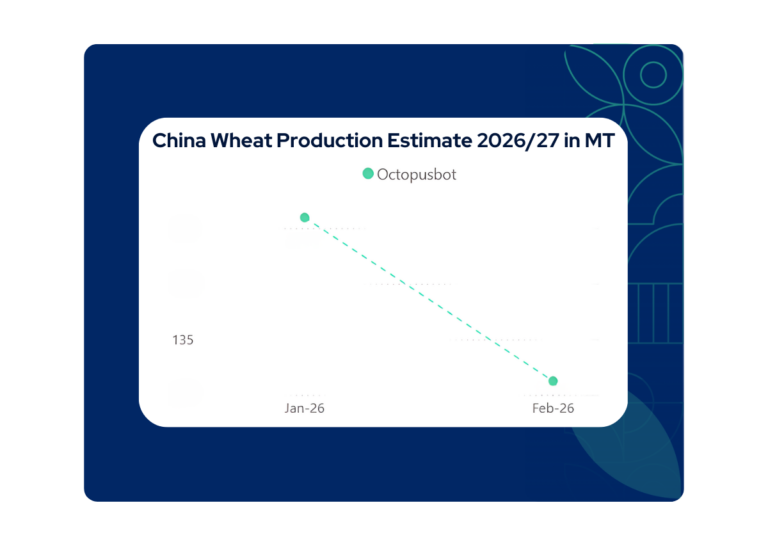
Latest China Wheat Production Estimate
Octopusbot has revised its latest China wheat production estimate for 2026/27 lower compared to the previous update. The downward revision is mainly driven by a significant soil moisture deficit during January across East, South Central, and Southwest China, covering approximately 73% of total wheat area. At the provincial level, the largest downward revisions were recorded in Henan, Anhui, Hebei, and Jiangsu.
The key drivers impacting the latest production estimate for China’s wheat production are:
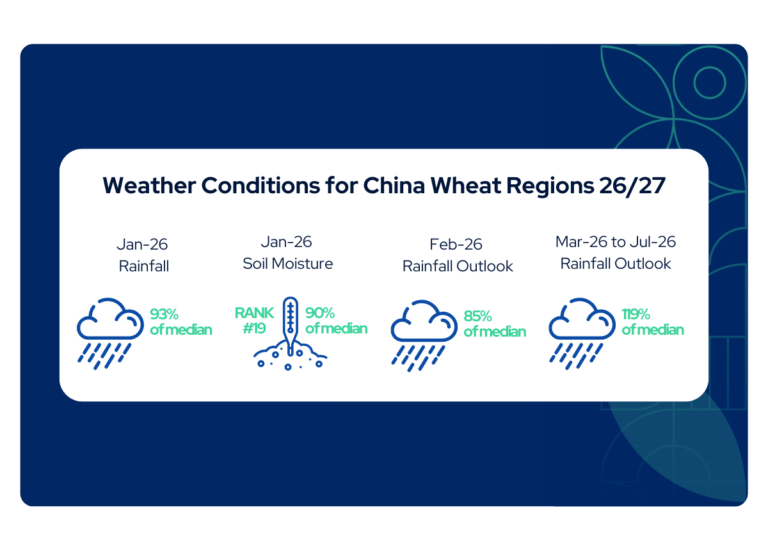
- Precipitation: January 2026 recorded lower-than-forecast rainfall (93% of the median vs. 118% forecast), with significantly below-median rainfall across East (79%), Northwest (71%), North (74%), and Southwest China (67%).
- Soil Moisture: Soil moisture remained persistently below median in January 2026 (90%). East China provinces show an extreme soil moisture deficit at 81% of the median, ranking #23 of the last 26 years.
- Seasonal Precipitation Outlook: February 2026 rainfall is forecast below median (85%), while March through July, precipitation is forecast above median (119%) across all wheat regions.
China’s wheat yields are projected lower compared to last season and below the five-year average. The decline reflects delayed winter wheat emergence following excessively wet sowing conditions, compounded by recent and persistent soil moisture deficits across major producing regions.
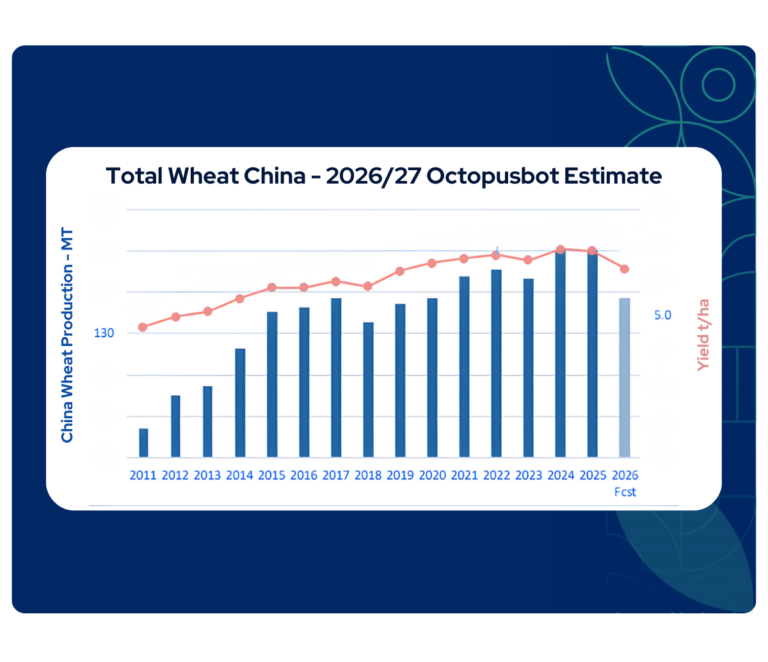
China’s wheat outlook in the new season 2026/27 illustrates how extreme weather volatility during critical growth stages can translate into lower yields and put downward pressure on production. However, China is not the only major wheat producer experiencing weather-driven disruption this season.
Latest India Wheat Production Estimate
India too has faced unfavourable conditions since late 2025. In December 2025, towards the end of sowing, wheat regions received only 11% of the median rainfall that impacted the yields negatively. This was followed by uneven and unseasonal January rainfall across key producing regions, further disrupting crop development. As the world’s second-largest wheat producer, developments in India carry significant implications for regional and global wheat supply in the new season 2026/27.
Octopusbot has revised its latest India’s wheat production estimate for season 2026/27 to be lower compared to the previous update in early January. The downward revision in February is driven by unseasonal rainfall across key wheat-producing districts and an increasingly wet harvest outlook.
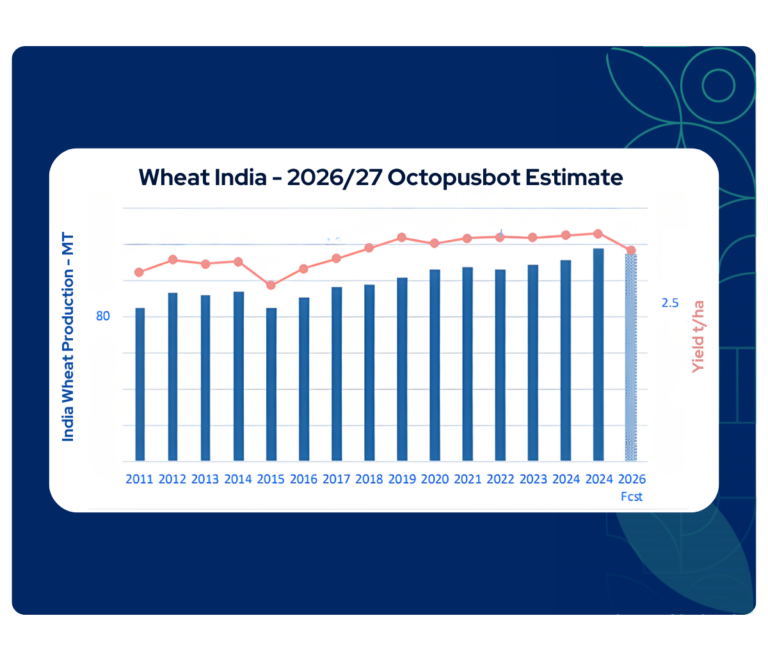
Despite an estimated increase in planted area year-on-year, production is expected to decline compared to last season due to weather-related yield pressure.
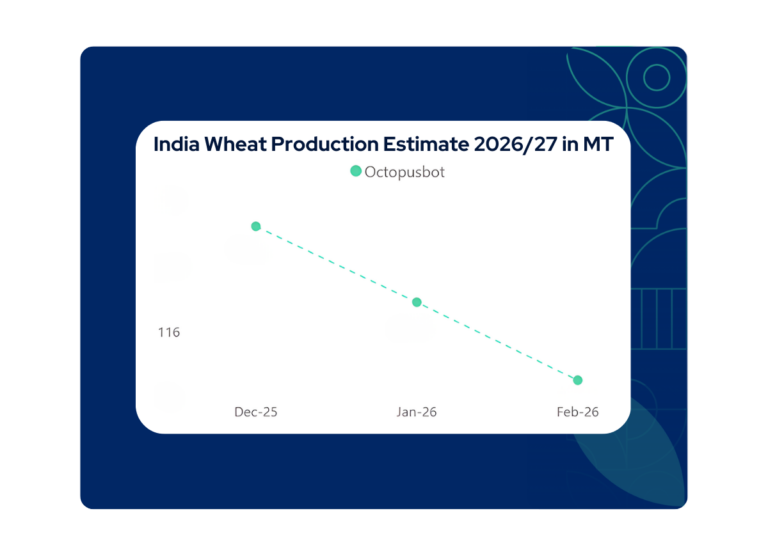
The key drivers impacting Octopusbot’s latest estimate for India’s wheat production are:
- Planted Area: Total wheat area is estimated 5% higher year-on-year based on government projections. However, weather-driven yield declines are outweighing the increase in planted area, leading to lower production estimates.
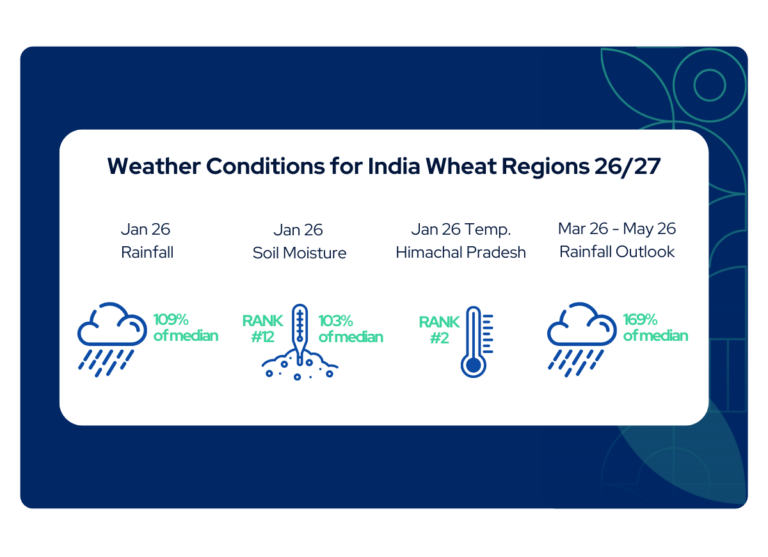
- Precipitation: January 2026 rainfall recorded 109% of the median across wheat-growing regions. However, rainfall distribution was highly uneven, with several key districts receiving more than 200% of the median, while others received less than 50% of the median.
- Soil Moisture: Soil moisture improved slightly in January (103% of the median), ranked #12 of the last 24 years across wheat regions. However, deficits below 90% persisted in parts of Himachal Pradesh.
- Temperature: January temperatures were close to median overall. However, Himachal Pradesh recorded high temperatures (101% of the median), ranking #2 of the last 24 years, adding stress in areas already facing moisture deficiency.
- Seasonal precipitation Outlook: February 2026 rainfall is forecast to be highly uneven across wheat regions, with overall precipitation exceeding 200% of the median. While some areas are expected to receive significantly below-median rainfall, extreme precipitation near 300% of the median is projected in Madhya Pradesh. From March–May 2026, above-median rainfall (~169% of the median) is forecast, indicating a wet harvest risk.
India’s wheat yields are projected to be lower than last year but above the five-year average, reflecting unfavorable weather conditions throughout the season to date. India’s wheat production took an early hit in the season with poor December 2025 rainfall during sowing, followed by unseasonal and uneven January 2026 rainfall during key growth stages, and a wet harvest outlook. This sequence of weather disruptions across critical crop stages is negatively impacting yield potential and putting downward pressure on production in the new season.
Octopusbot Past Forecast Accuracy
In seasons shaped by extreme weather events, understanding how those disruptions translate into yield-driven production shifts becomes critical to assessing supply trends.
Octopusbot’s technology combines historical and prevailing weather conditions with historical yield data to produce accurate forecasts for the season. By analysing crop response to sequential weather shocks across regions and growth stages, Octopusbot ensures forecasts are grounded in multi-dimensional data rather than single weather events.
This enables growers, traders, and agribusinesses to stay informed with regional & global coverage impacting global prices, make smarter data-driven decisions, mitigate risks with confidence, and ultimately maximize profits with accuracy. Octopusbot continues to demonstrate its ability to identify yield-driven production trends well ahead of traditional agencies.
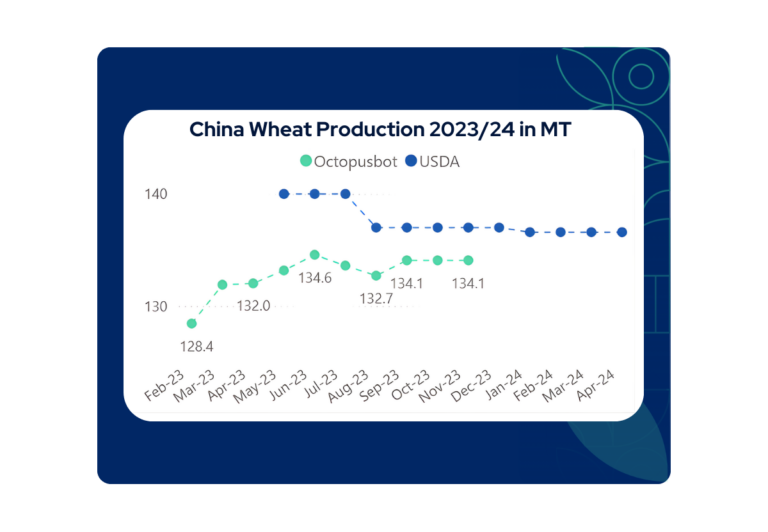
In March 2023, Octopusbot predicted that the season’s production trend for China wheat within 95% accuracy range, 10 months before the final estimate and 2 months before the USDA, with a difference of 1.8% on the final estimate.
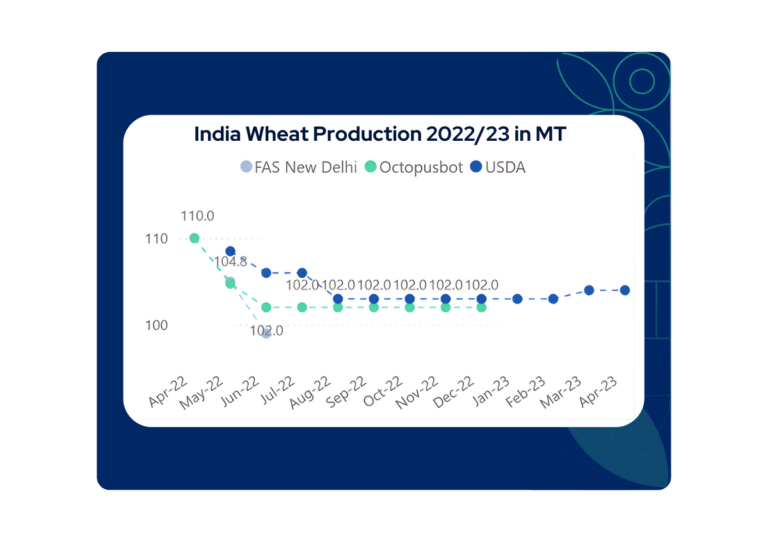
In May 2022, Octopusbot predicted the season’s production trend for India wheat within 95% accuracy range, 10 months before the final estimate with a difference of only 1.9% on the final estimate.
 For full, detailed AI forecasts on China wheat and corn, India wheat, lentils and chickpeas & more:
Comments are closed