
As we head into the 2026/27 wheat season, Octopusbot’s AI-driven models indicate that Russia’s wheat production is expected to decline compared to last season, mainly due to reduced planted areas.
This outlook reflects a combination of limited farmer incentives to plant amid rising financial pressures and persistent dryness across key winter wheat regions, which has continued to affect planting progress and field conditions during the current sowing period.
In this analysis, we present Octopusbot’s first estimate for the 2026/27 season, explore the key factors influencing Russia’s wheat outlook, and highlight how AI-powered forecasting provides early visibility into emerging production risks months before official releases.
Farmer Financial Stress Adds to Production Risks
Russia’s grain industry continues to face deepening financial pressure, which has eroded farmers’ ability and incentive to plant wheat in the upcoming season. Over the past 5 years, nearly 35,000 grain farmers have faced bankruptcy as profitability collapsed under the combined weight of export duties, high input costs, and limited access to affordable credit. The continuation of export duty, originally introduced as a temporary price stabilisation measure during the pandemic, has further tightened margins, leaving many growers unable to recover from prior losses.
Despite the reduction in the Bank of Russia’s key rate to 16.5% per annum (as of October 2025), agricultural loans remain costly, limiting farmers’ access to affordable credit. At the same time, fertiliser, fuel, and energy prices continue to rise, while domestic grain prices remain flat, making it increasingly difficult for farmers to cover production costs and be profitable.
These financial constraints have forced many growers to cut fertiliser use, reduce field operations, or switch to alternative crops such as sunflower seeds, which currently offer better returns. However, this shift risks long-term soil degradation and highlights the mounting financial pressure facing cereal producers. Collectively, these factors are expected to keep wheat planted areas lower for the 2026/27 season, adding another layer of risk to Russia’s production outlook.
Persistent Dryness Across Key Wheat Regions
The 2026/27 winter wheat planting in Russia began under challenging conditions, with soil moisture levels across key growing regions remaining well below the long-term median during the planting months of September and October. The Southern, Central, and Volga districts, which together account for about 75% of Russia’s winter wheat area, have experienced persistent dryness.
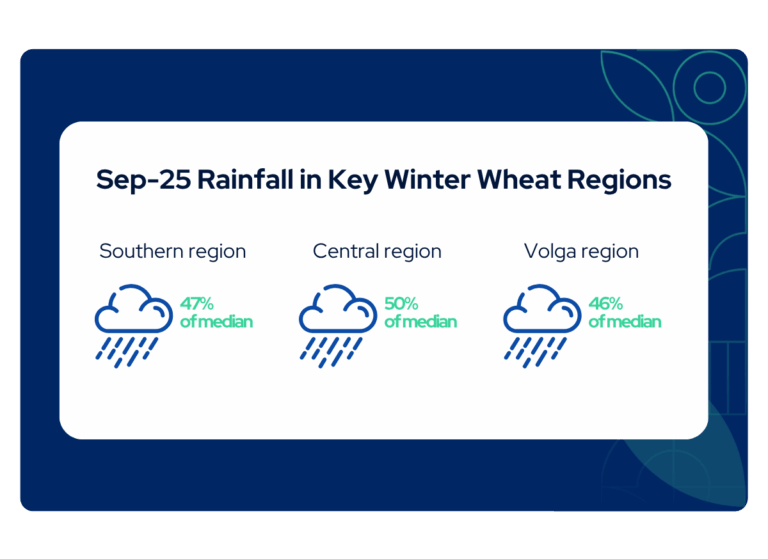
In September 2025, rainfall was recorded at 47% of the median in the Southern region, 50% in the Central, and 46% in the Volga region, resulting in below-median soil moisture across Russia’s main wheat belt. Corresponding soil moisture levels stood at 95%, 88%, and 87% of the median, indicating dry field conditions heading into October. The pattern persisted through October, when all three regions recorded significantly below-median precipitation and continued soil moisture deficits in the winter wheat regions.
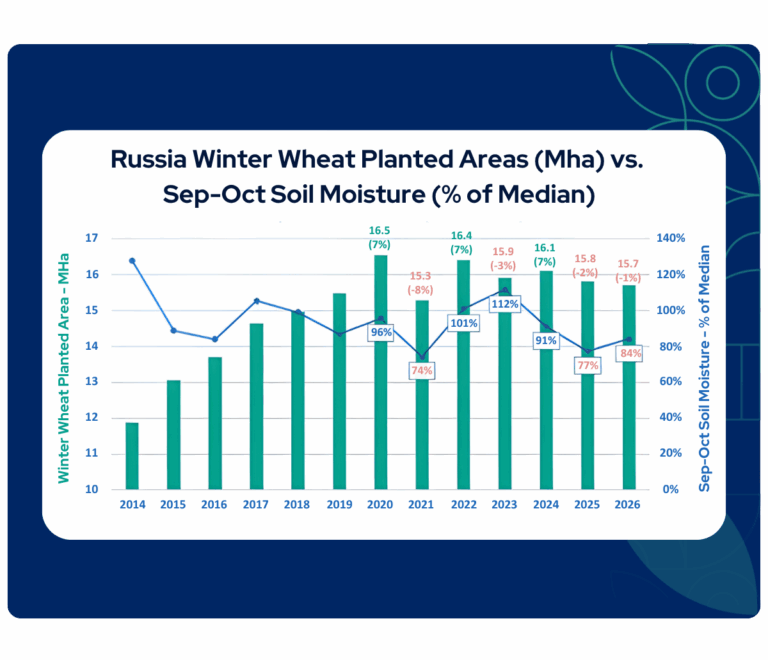
The chart compares Russia’s winter wheat planted area during the planting season with soil moisture levels. Historically, years with either significant moisture deficits or overly wet conditions have coincided with smaller planted areas. While soil moisture in 2025 was slightly higher than last year (84% compared to 77% last year), planted area has still declined, suggesting that financial and policy pressures, alongside dry conditions, are influencing farmer decisions this season.
Octopusbot Russia Wheat Estimate
Octopusbot’s first estimate for Russia’s 2026/27 wheat season projects total production to be around 5% lower than last season and below the five-year average. The decline is mainly driven by reduced planted areas and low soil moisture during the winter wheat planting season. Total wheat yields are also estimated to be lower than last year, consistent with dry planting conditions observed through September and October 2025.
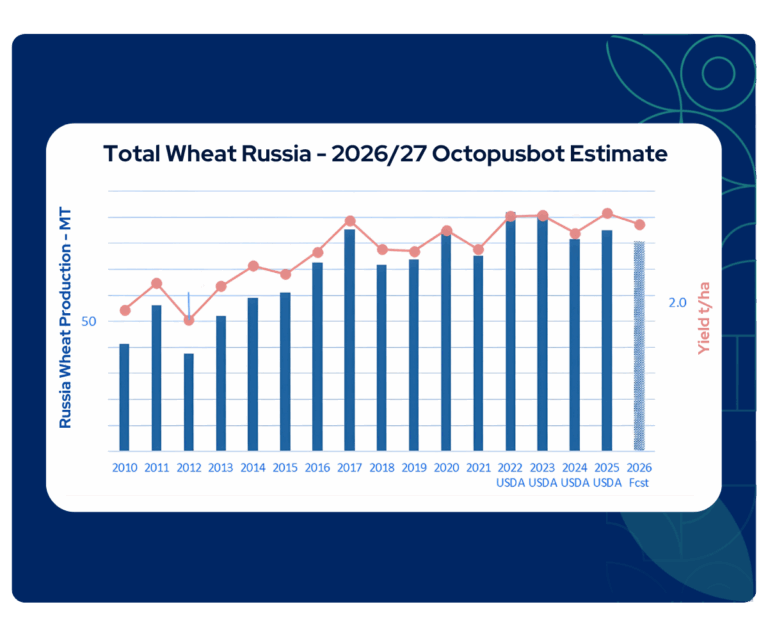
The key drivers impacting Russia wheat production in the 2026/27 season are:
- Planted Area: Total wheat planted area reduced by 0.6% compared to last year.
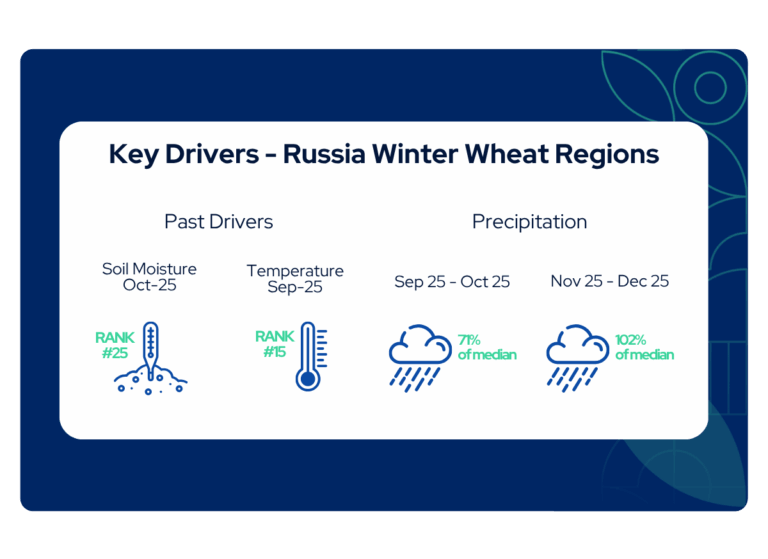
- Soil Moisture: Severe soil moisture deficits persist across key winter wheat regions, ranking 16th driest in September and 25th driest in October of the past 25 years.
- Temperature: Temperatures were near-median to below median in September 2025 in most wheat growing regions.
- Precipitation: Across Russia’s winter wheat regions, September 2025 rainfall was 65% of the median, and October 2025 conditions near 77% of the median. November – December 2025 rainfall is forecast 102% of the median, while January – March 2026 is forecast at 97% of the median.
Octopusbot’s Forecast Accuracy
For the upcoming 2026/27 season, Octopusbot provides a data-driven assessment of Russia’s wheat production outlook, powered by technology that combines hundreds of weather parameters with historical yield data at the district level to generate early and accurate estimates of planted areas and yield potential.
Octopusbot’s first estimate comes ahead of official estimates, enabling growers, traders, and agribusinesses to maximize profits with accuracy, mitigate risks with confidence, make smarter data-driven decisions, and stay informed with regional and global coverage.
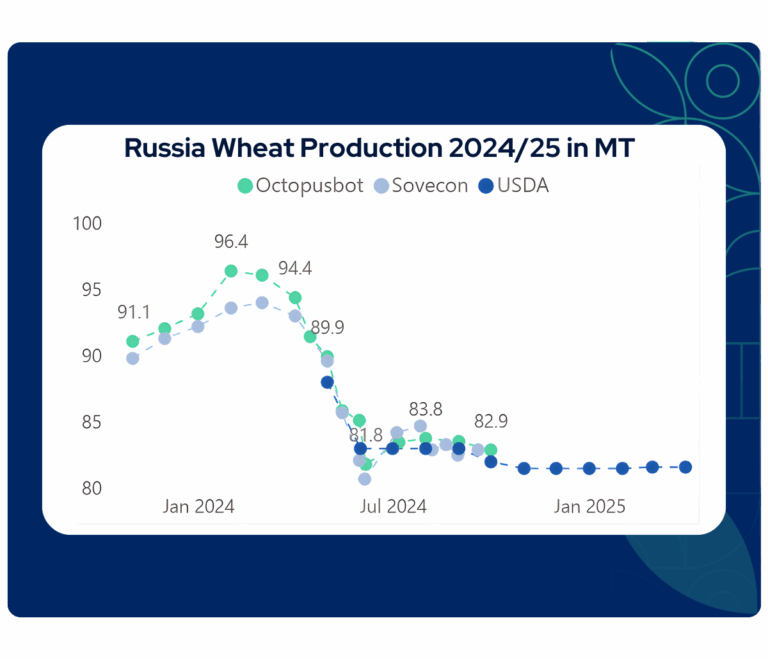
Over past seasons, Octopusbot’s AI forecasts have consistently demonstrated high accuracy, capturing production trends well before official releases. In May 2024, Octopusbot successfully quantified the impact of the frost events ahead of other agencies and within a 95% accuracy and 5 months before the final estimate, with a difference of 1.6% on the final estimate.
With early and accurate estimates, Octopusbot aims to strengthen decision-making across the grain value chain, empowering the industry to navigate every season with confidence.
 For full, detailed AI forecasts on Black Sea wheat, corn, barley & more:
Comments are closed