
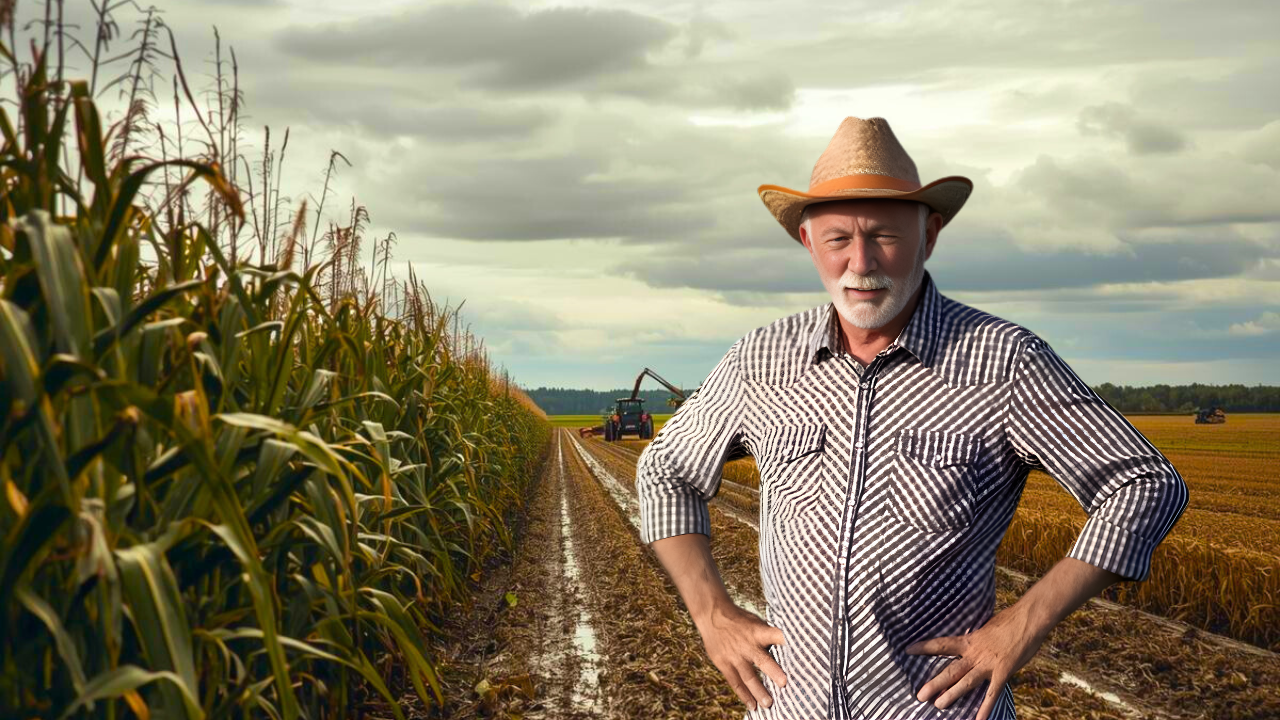
As Ukraine’s 2025/26 corn harvest is underway, progress has been severely delayed, with a substantial share of the crop still in the fields even into the first week of December. Persistent harvest rains have created extremely wet conditions, slowed operations and increased the likelihood of unharvested areas this season.
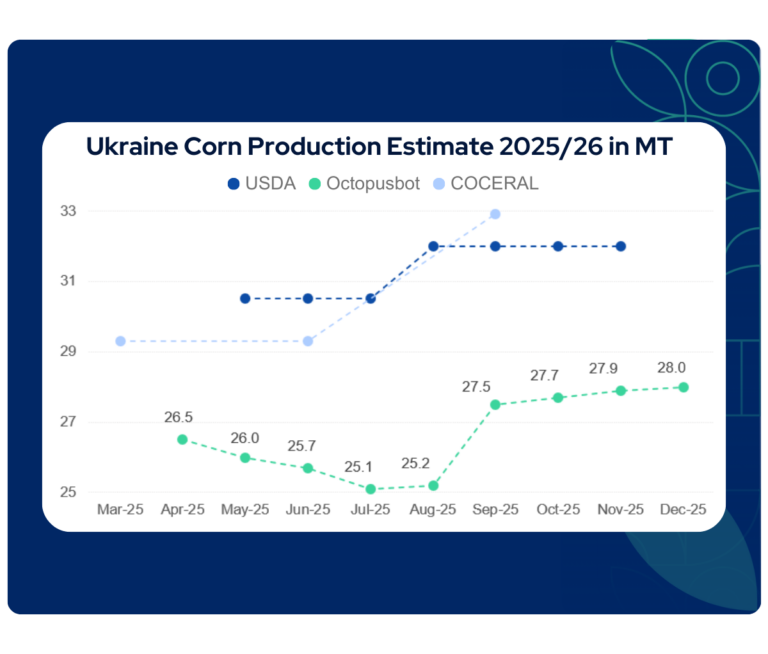
Octopusbot’s AI-driven models have projected lower Ukraine corn production since the start of the season. The models first reflected this during April 2025, when late sowing and unfavourable conditions during key growth stages emerged across major producing regions. The excessive harvest rains now delaying progress and posing the risk of unharvested areas further reinforce the lower production projected by Octopusbot’s models compared to official estimates held by USDA and COCERAL.
In this analysis, we explore how Octopusbot identified this production trend as early as April 2025, why the models continued to point to lower estimates and how current harvest progress supports this outlook.
Field Conditions Driving Down Ukraine Corn Production
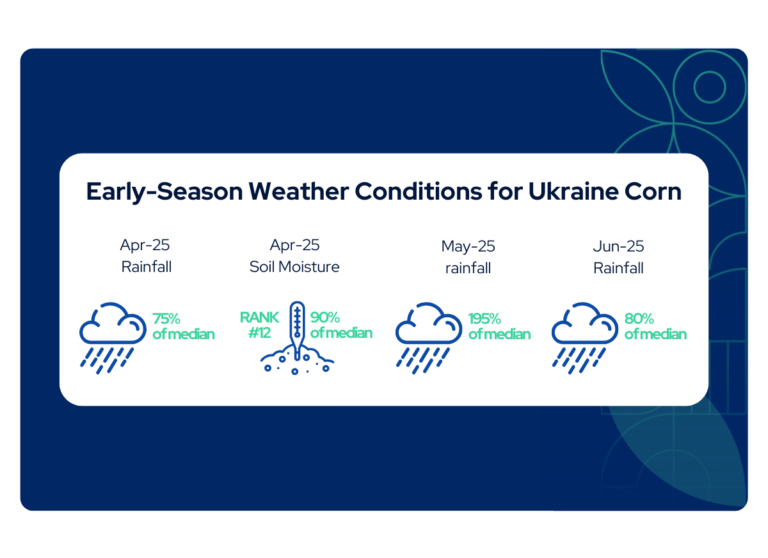
Ukraine’s 2025/26 corn season began under dry sowing conditions, with April 2025 rainfall at 75% of the median and soil moisture at 90% of the median. These moisture deficits delayed planting across major producing regions and pushed crop development later into the season. Octopusbot’s models have reflected lower production than official estimates since this early stage, as late planting increases the likelihood of harvesting during the period of heavier rains.
Weather during the main growth phases added further pressure to yields. May recorded excessive rainfall at 195% of the median, creating saturated soils during early growth, followed by below-median June rainfall at 80%. This extreme fluctuation in moisture conditions during key growth stages contributed to weaker yield potential through mid-season.
As the season progressed, heavy rains at the start of harvest continued to challenge the crop, with soil moisture reaching 113% of the median in October and 106% in November, creating extremely wet field conditions. The slow harvest extending into December now poses the risk of unharvested areas and supports Octopusbot’s lower production estimates for the season.
Risk of Unharvested Areas Due to Excessive Harvest Rains
Ukraine’s 2025/26 corn harvest has been extremely delayed, with only 78% of the crop harvested, amounting to 23.5 MT, even into the first week of December, leaving a substantial share still in the fields. Persistent wet conditions during the harvest window have slowed progress and pushed operations later into the season, when completing the remaining area becomes increasingly challenging.
Farmers now face a difficult choice. Harvesting all the crop under very wet conditions results in grain with high moisture levels, requiring costly post-harvest drying. In many regions, drying costs outweigh the value of the grain, making it uneconomical to continue harvesting. As a result, growers may be forced to leave part of the crop in the field, increasing the likelihood of unharvested areas this season.
With progress stalled and field conditions unlikely to improve meaningfully in December, the risk of unharvested areas remains high, supporting Octopusbot’s production estimates that are lower than the official figures from USDA at 32.0 MT and COCERAL at 32.9 MT.
Octopusbot Ukraine Corn Estimate
Octopusbot’s latest estimate for Ukraine’s 2025/26 corn production has increased slightly compared to the previous estimate by Octopusbot, due to lower-than-forecast rainfall in November 2025 (106% vs. 125% forecast) at the time of harvest. Even with this upward revision, Octopusbot’s latest production estimate of 28 MT remains 12.5% below USDA and 14.9% below COCERAL, reflecting field conditions not yet captured in official estimates.
Octopusbot has consistently projected lower Ukraine corn production since the start of the season. The models first reflected this in April 2025, when late sowing caused by moisture deficits increased the likelihood of harvesting during the period of heavier rains. This has now materialised, contributing to slow progress and the risk of unharvested areas. The mid-season increase in August reflected the discovery of higher planted areas, but the overall production direction remained lower throughout the season.
Octopusbot’s AI-driven models, which combine hundreds of weather parameters with historical yield data at regional level, captured the impact of these field realities 7 months ago.
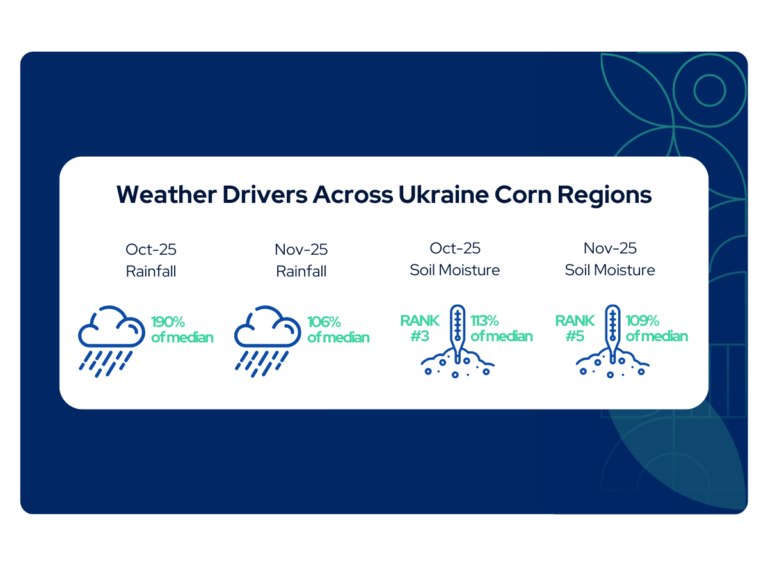
The latest key drivers impacting Ukraine corn production for season 2025/26 include:
- Precipitation: October 2025 recorded significantly above-median and higher-than-forecast rainfall at 190% vs. 149% forecast. November 2025 recorded 106% of the median rainfall.
- Soil Moisture: Soil moisture improved from rank #9 to rank #3 of the last 15 years in October 2025, reaching 113% of the median. November 2025 recorded soil moisture at 109% of the median.
Yields are forecast to be lower than last season and below the five-year average, reflecting early moisture deficits during sowing and unfavourable weather through key growth stages.
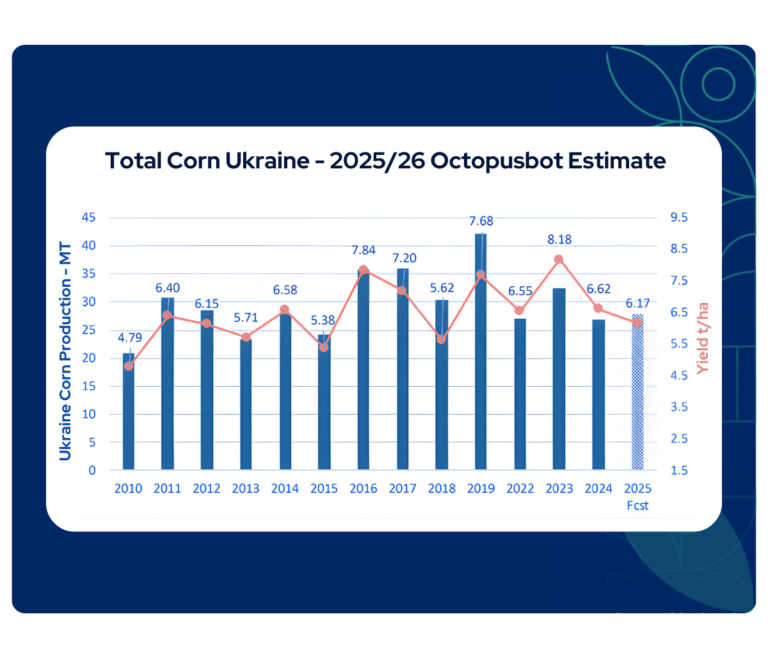
Interpreting Ukraine’s Harvest Progress and Likely Production Outcomes
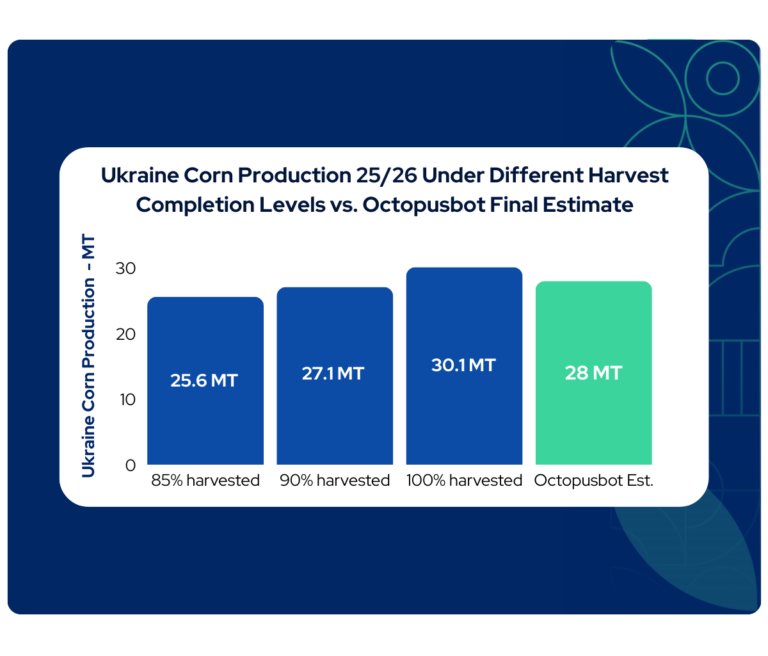
Ukraine’s reported harvest progress provides important insight into where final production of Ukraine’s corn is likely to land this season. As of 4 December 2025, 23.5 MT of corn has been harvested from 78% of the planted area. If harvest were to reach full completion, this pace would imply a total production close to 30.13 MT.
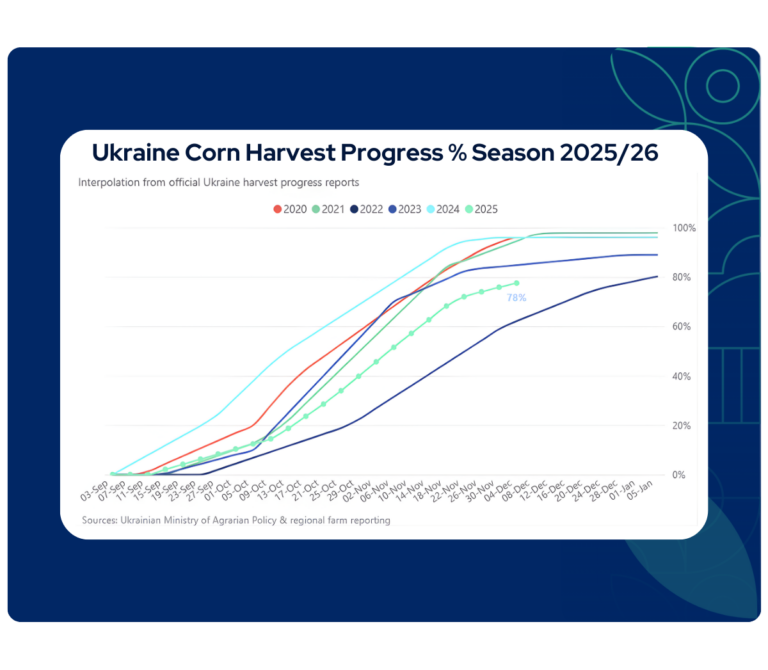
However, given the highly probable risk of unharvested areas due to ongoing wet conditions, a more realistic assessment falls within an 85% to 90% completion range. At 85% harvested, production would be around 25.6 MT, and at 90% harvested, it would be closer to 27.1 MT. This indicates that final production is more likely to align with Octopusbot’s estimate of 28 MT rather than the higher estimates reported by USDA at 32 MT and COCERAL at 32.9 MT.
Octopusbot’s Forecast Accuracy
Octopusbot provides a data-grounded assessment of Ukraine’s corn production for season 2025/26 by analysing monthly changes across hundreds of weather parameters, field assessments and historical yield relationships. Octopusbot’s models capture in-season developments and reflect field conditions that influence production well ahead of traditional agencies.
Octopusbot’s AI forecasts have consistently identified production trends ahead of official estimates, helping growers, traders and agribusinesses anticipate supply changes earlier and make smarter data-driven decisions. By quantifying weather impacts in real time, Octopusbot enables grain market participants to anticipate seasonal shifts and their impact on yields with greater accuracy and lead time.
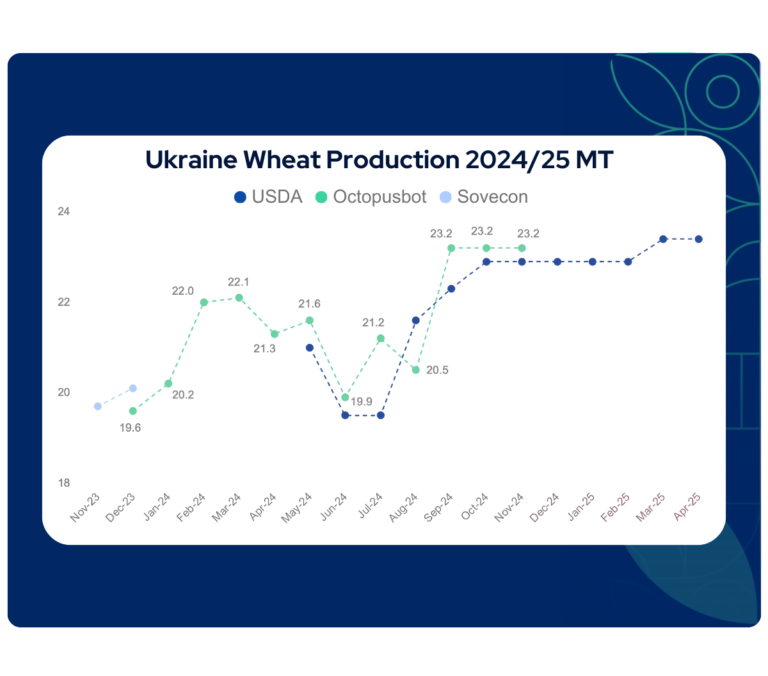
Octopusbot’s accuracy for Ukraine crops has strengthened as the models integrate more seasonal data and enhancements each year. For example, in February 2024, Octopusbot predicted the season’s production trend for Ukraine wheat within 95% accuracy range, 9 months before the final estimate and 7 months before USDA, with a difference of 0.9% on the final estimate.
 For full, detailed AI forecasts on Ukraine wheat, corn & Black Sea:
Comments are closed