
Octopusbot’s Lower Yield Estimates vs. USDA
The August 2025 USDA crop estimates for U.S. corn and spring wheat have sparked debate in the market. While USDA’s figures point to near-record yields for corn and strong performance in spring wheat, Octopusbot’s AI-driven forecasts present a more cautious outlook. This divergence has important implications for pricing strategies and risk management.
U.S. Corn Yield History
This chart illustrates how USDA’s August corn yield forecasts have compared to the final January figures over the past two decades. Notably, in August 2025, the USDA projected U.S. corn yields at record levels, about 5.3% above the previous high (highlighted in the chart), even though August forecasts have historically been revised downward in years with late-season weather stress.
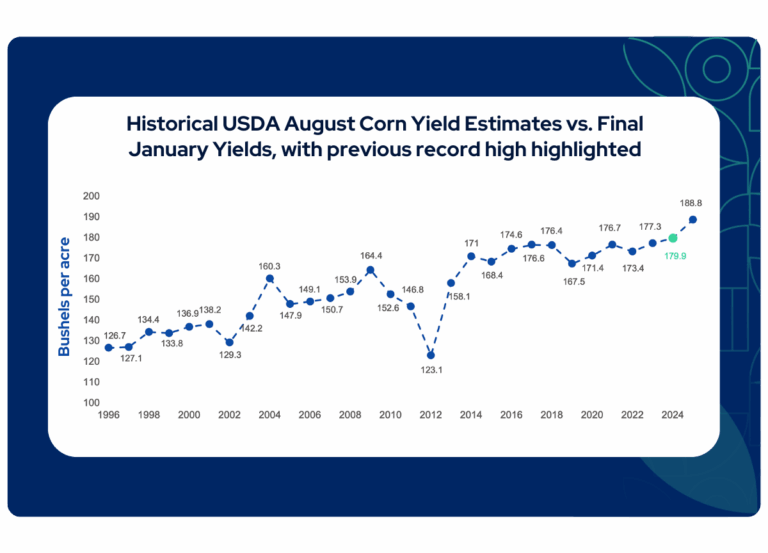
While the USDA methodology incorporates survey data and field assessments, early-season optimism is a consistent feature of August estimates. Historical revisions suggest that August figures often overstate yield potential.
This early-season overestimation may be aimed at easing inflationary pressures, as higher yield forecasts push prices lower at a time when tariff reductions are lifting domestic prices and rising unemployment reflects economic strain.
Why the 2025 USDA Estimate Seems High
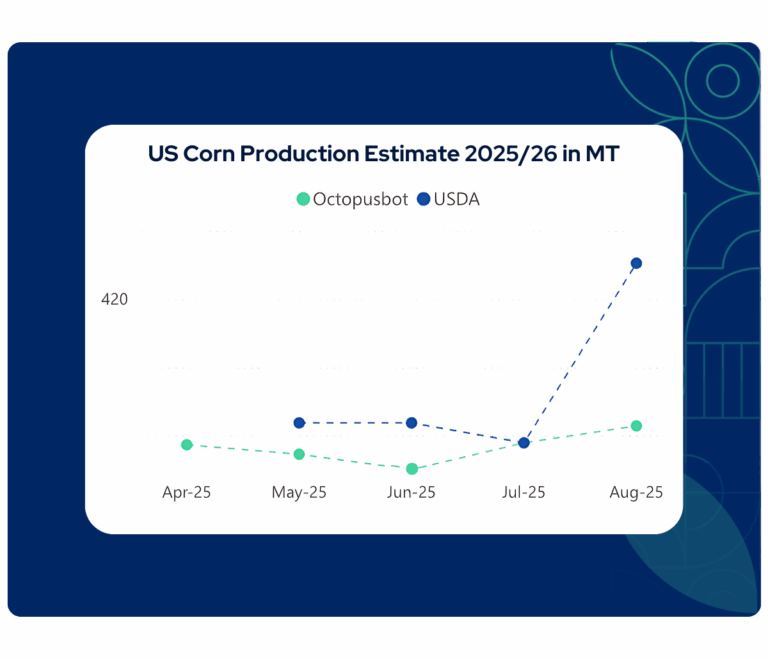
This season’s latest USDA corn production estimate is about 6% higher than Octopusbot’s August estimate. While USDA figures remain optimistic, they do not fully capture the challenges observed in the season. Octopusbot’s models account for below-median rainfall during the crop’s mid-season, above-median rainfall expected at the time of harvest, and high July temperatures in key producing regions – all of which negatively impact yields.
U.S. Corn Production Outlook
Octopusbot’s August estimate for U.S. corn production has increased compared to the previous estimate, supported by improved rainfall and soil moisture conditions. However, the forecast remains well below USDA’s estimates, reflecting lower yield potential. Octopusbot’s technology combines hundreds of weather parameters with historical yield data at county level to precisely forecast yields for the season. Using these technologies, Octopusbot’s models incorporate the impact of mid-season dryness, high temperatures in key corn regions in July, and above-median rainfall expected during harvest, factors that USDA’s figures do not fully reflect.
Weather Drivers for Corn Production
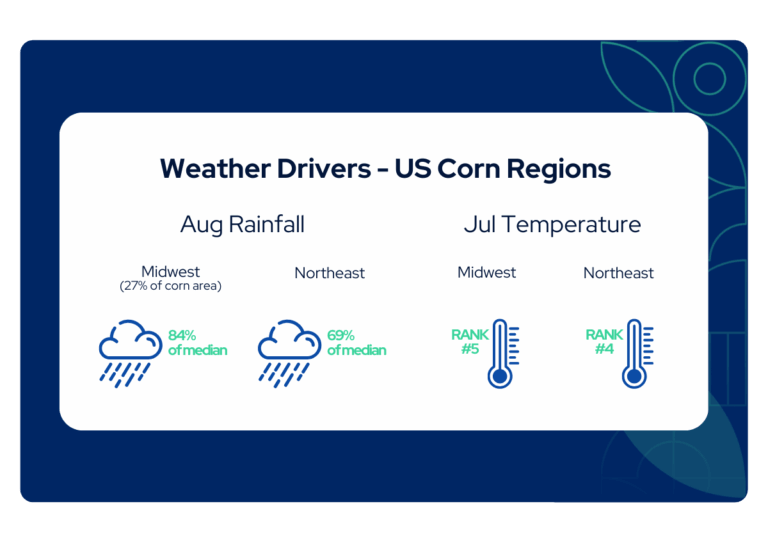
- Precipitation Outlook: August precipitation is forecast near median overall, but below median in the Midwest (84% of median; ~27% of corn area), the Northeast (69%), and the West (98%). From September to October, rainfall is forecast above median (108% of the median), which during the harvest season negatively impacts yields.
- Temperature: July 2025 recorded high temperatures in Midwest (rank #5 of the last 24 years) and Northeast (rank #4 of the last 24 years) during the crop’s mid-season which reduced yield potential.
Wheat Estimates: Smaller Gap, Different Dynamics
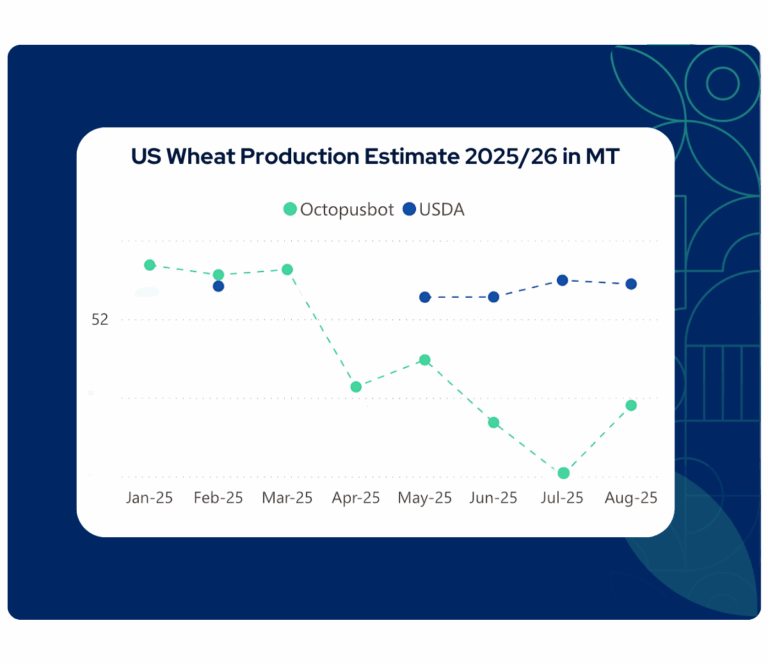
Octopusbot’s latest spring wheat production estimate is below USDA’s August estimate. The difference is smaller than in corn, at around 3%, but still reflects USDA’s more optimistic outlook.
Spring wheat yields for the 2025/26 season are projected lower than last year due to April – June soil moisture deficits. The latest USDA spring wheat condition score ranks #20 of the last 24 years, lower than 2024 (87%) and the five-year average (99%), reinforcing Octopusbot’s lower production estimates compared to USDA.
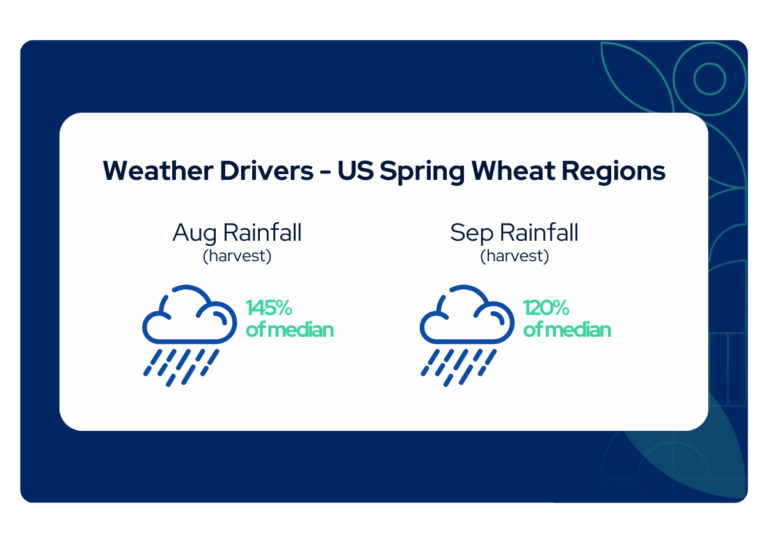
Above-median rainfall is forecast for August–September, during the spring wheat harvest. This is expected to negatively impact yields, a factor not fully reflected in USDA’s figures.
Weather Drivers for Spring Wheat Production
Precipitation Outlook: In August, spring wheat regions are forecast to receive 145% of median rainfall. September rainfall is also forecast above median, at 120%. Rainfall during harvest is expected to limit yield potential.
The differences between USDA and Octopusbot estimates for 2025 corn and spring wheat highlight the importance of weather-driven analysis. While USDA estimates remain influential for market sentiment, Octopusbot’s AI models incorporate real-time weather data and soil conditions that better capture yield risks during mid-season and harvest. For farmers, traders, and agribusinesses, understanding these divergences is key to anticipating potential adjustments in production and market outcomes as the season advances.
Octopusbot’s Forecast Accuracy
Octopusbot’s models have consistently demonstrated accuracy in past seasons, capturing weather-driven yield shifts earlier than traditional estimates. Looking at previous years provides context on how these models perform under varying conditions and why they offer a reliable benchmark against USDA figures.
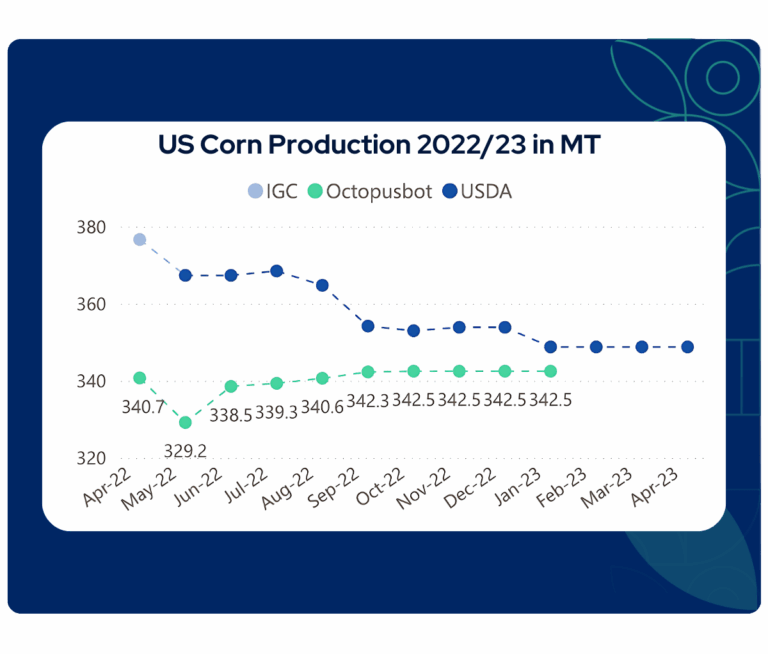
In April 2022, Octopusbot predicted that the season’s production would trend lower for corn, 9 months ahead of the USDA’s prediction with a difference of only 1.8% in the final estimate.
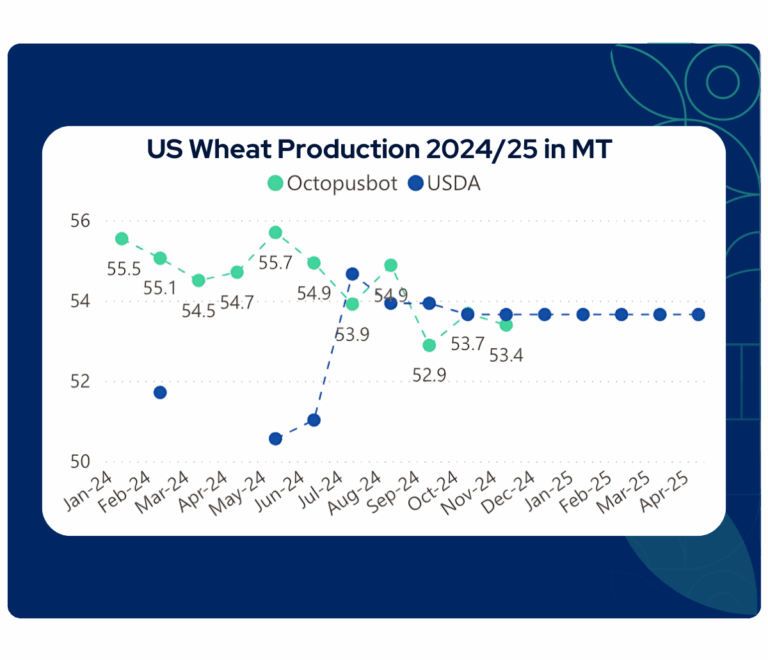
In January 2024, Octopusbot predicted the season’s production trend for wheat within 95% accuracy range, 10 months before the final estimate and 6 months before USDA, with a difference of 0.6% on the final estimate.
Comments are closed