

Across the Black Sea, the 2026/27 wheat season is shaping as a strong production year for both Russia and Ukraine. Above-median soil moisture, favourable rainfall through the early and mid-season, and a positive precipitation outlook are driving higher yield potential across key growing regions.
In Russia, this represents a clear recovery from last season. In 2025/26, Octopusbot’s models quantified the impact of frost events on winter wheat yields early in the season, identifying production around 9% lower than official estimates while most agencies maintained higher estimates. In the 2026/27 season, above-median rainfall and soil moisture across Central and Southern districts, combined with adequate snow cover through winter, have supported a return to strong yield potential. Similarly in Ukraine, favourable early-season conditions are supporting a better crop than last year.
Octopusbot’s models forecast higher production for the 2026/27 season across both Russia and Ukraine, increasing the likelihood of higher Black Sea supply and a bearish wheat market into the August harvest window.
This blog explores how Octopusbot’s models quantify the impact of precipitation, soil moisture, and frost risks on yields across the crop cycle, with satellite data reinforcing the production trends identified by the models, and how these developments are shaping the latest estimates for Russia and Ukraine wheat in the 2026/27 season.
A Strong Russian Wheat Crop Emerges Under Favourable Seasonal Conditions
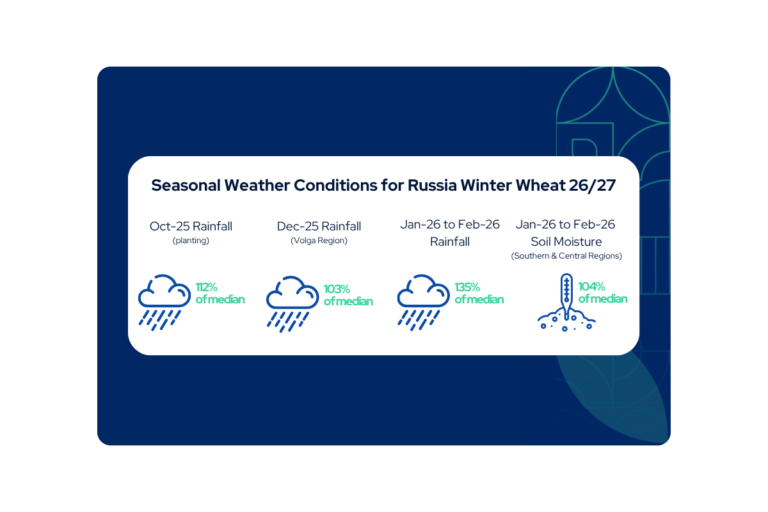
Russia’s winter wheat crop for the 2026/27 season started under favourable conditions, with Central and Southern regions, which account for ~55% of total winter wheat area, receiving above-median rainfall during planting in October (112% of median), supporting strong early crop establishment.
Conditions remained favourable through the mid-season across these regions, with continued above-median rainfall and soil moisture. The Volga region remained dry through the early part of the season, before above-median rainfall in December (103% of median) improved soil moisture and supported a recovery in yield potential.
In January, market focus shifted to frost risks across southern Russia, particularly in Krasnodar. Snow depth remained above median (130%, rank #8 of the last 25 years), while January recorded an elevated number of cold days (rank #5 coldest). However, temperatures did not reach levels associated with winterkill, and no material impact was observed on winter wheat.
Rainfall in January and February remained above median (135%), with soil moisture above median across Central and Southern districts (~104%). Snow depth also remained consistently above median through the winter period. Overall, the weather conditions observed through the season so far have been favourable, supporting a strong Russia wheat crop.
Latest Russia Wheat Production Estimate
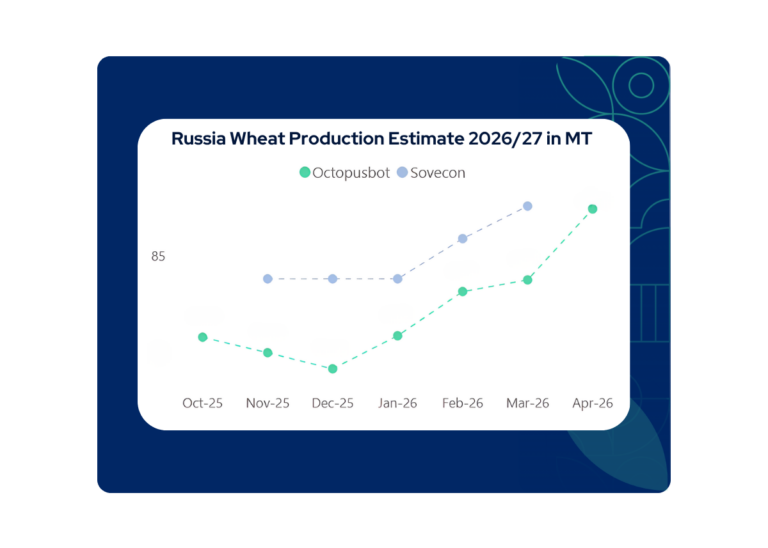
Octopusbot’s latest estimate for Russia wheat production in the 2026/27 season was revised higher compared with the previous update, supported by above-median soil moisture across winter crop regions. Gains were led by Southern regions, particularly Rostov.
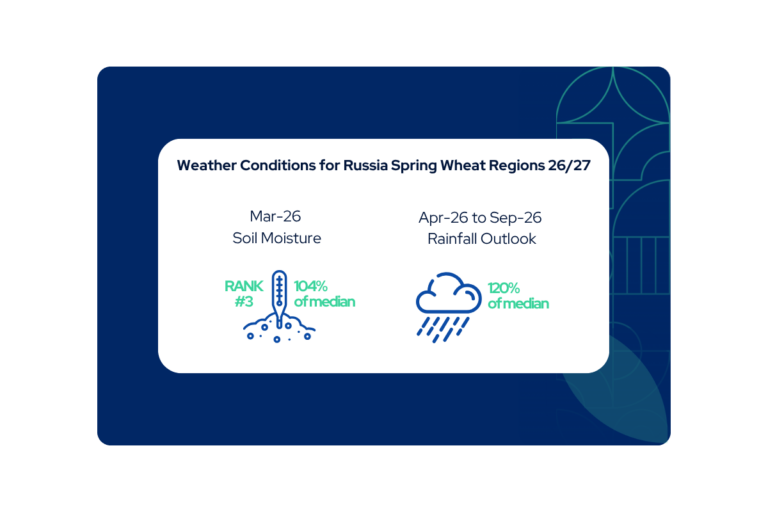
Spring wheat conditions have also contributed to the higher estimate, supported by favourable soil moisture for planting (rank #3 of the last 25 years) in March 2026 and a positive precipitation outlook across spring wheat regions (~120% from Apr–Sep 2026).
The key drivers impacting the latest production estimate are:
- Planted Area: Winter wheat planted area is estimated 0.63% lower year-on-year due to low soil moisture during planting in the Volga region.
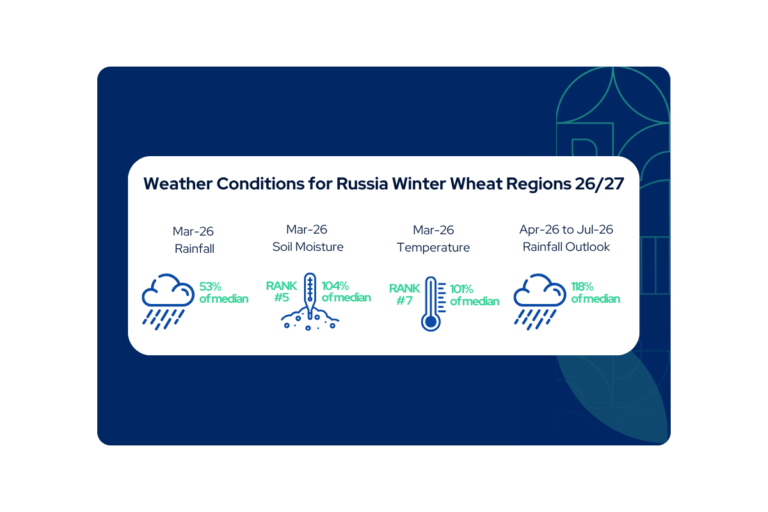
- Precipitation: March 2026 rainfall was below median and below forecast, reaching 53% of the median compared with 78% forecast in the winter wheat regions.
- Soil Moisture: Soil moisture remained above median nationally (104%, rank #5 of last 25 years), with Southern and Central regions ranking #3 of the last 25 years.
- Snow Depth: Snow depth remained above median (129%), ranking #7 of the last 25 years.
- Frost and Temperatures: March recorded a below-median number of cold days below −12°C, while temperatures remained above median (rank #7).
- Precipitation Outlook: Rainfall is forecast above median from April through July (~118%) across winter wheat regions.
Wheat yields are projected higher than last year and above the five-year average, reaching the highest levels on record. Winter wheat yields are estimated well above median and the second highest on record (based on pre-2021 history), mainly driven by favourable mid-season conditions in winter wheat regions, particularly in Central and Southern districts, and a positive rainfall forecast across both winter and spring wheat regions.
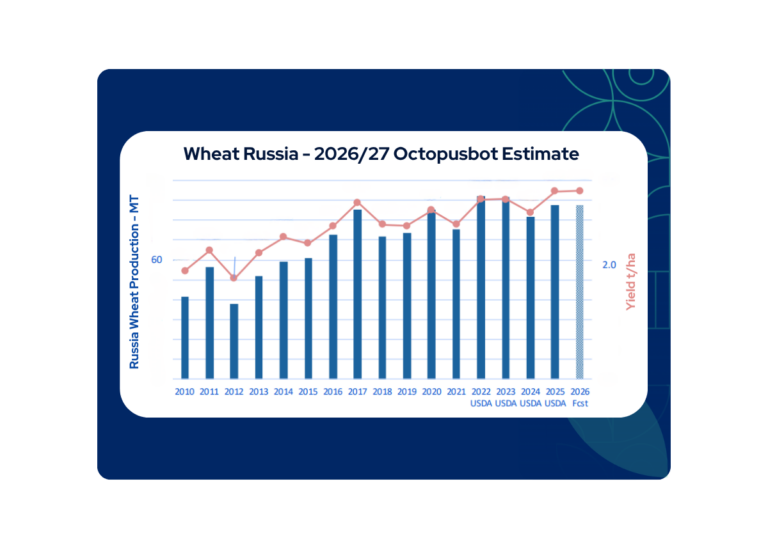
NDVI Data Reinforces Strong Crop Conditions Across Key Russia Wheat Regions
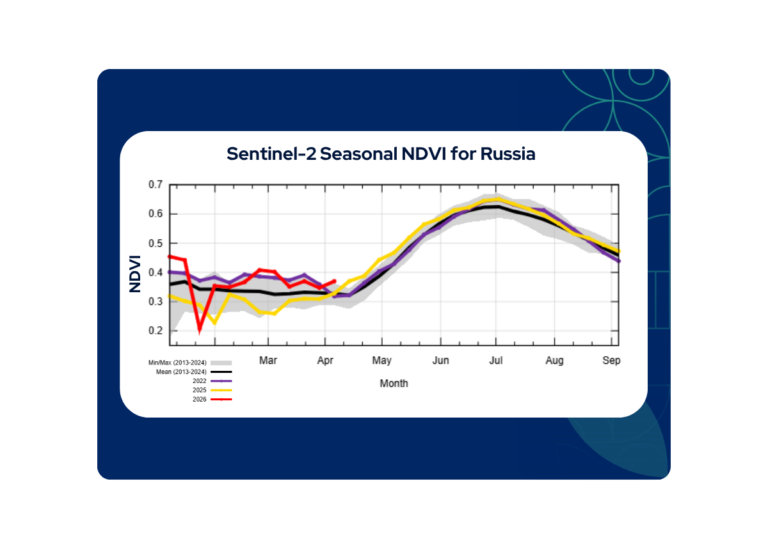
Satellite data further supports the strong Russia wheat crop outlook projected by Octopusbot. Latest Sentinel-2 NDVI data indicates that crop conditions in 2026 are tracking above the historical mean, with levels exceeding both the long-term average and recent years.
At the national level, NDVI for 2026 (red line) is tracking above the historical mean (black line) and above 2022 levels (purple line), which was officially reported as the highest crop on record. This indicates that current crop conditions are stronger than previous high-production years.
At the regional level, Krasnodar and Rostov, which together account for approximately 30% of Russia’s winter wheat area are also tracking well above last year and the historical mean, reinforcing strong crop performance across the country’s most important winter wheat areas.
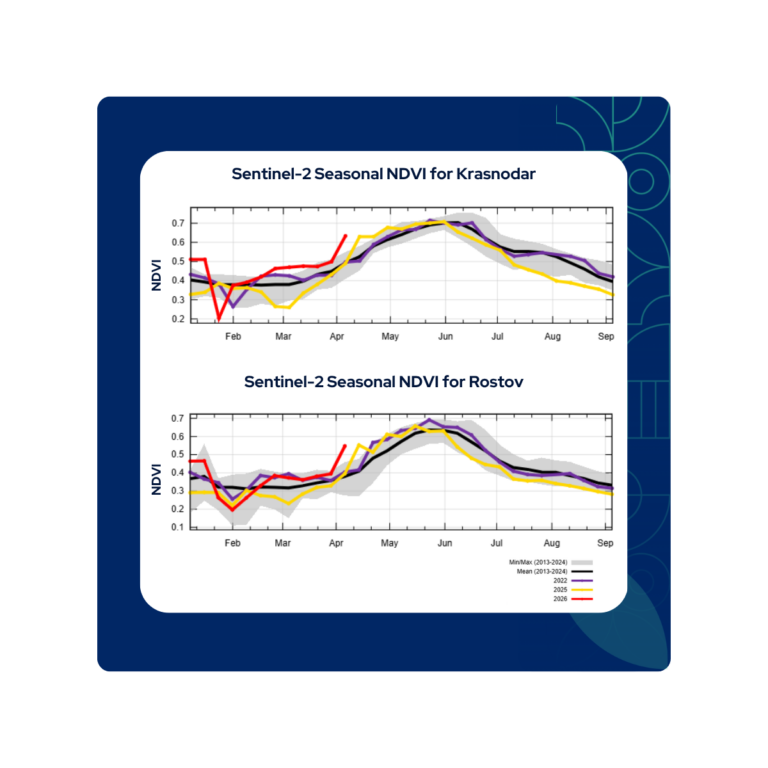
These NDVI trends confirm that satellite data is aligned with Octopusbot’s model forecasts, supporting the projection of a strong Russia wheat crop for the 2026/27 season.
Strong Ukraine Wheat Crop Supported by Favourable Early Season Conditions
Ukraine’s wheat crop for the 2026/27 season has benefited from favourable early-season conditions, with soil moisture remaining above median since the start of the season. In November, national soil moisture reached 107% of median, ranking #5 of the last 16 years, supporting strong crop establishment.
Through the season, higher-than-forecast precipitation supported crop conditions, with Octopusbot’s models progressively increasing production estimates through to March. Soil moisture remained above median across major wheat-producing regions from December through to February (~103%), supporting yield potential through key stages of the crop cycle.
Market concerns around frost events emerged during January, with a high number of cold days below 0°C (rank #2 of the last 16 years nationally), particularly across Northern and Western regions (rank #1). However, Octopusbot’s models quantified that these conditions did not translate into material yield losses, with snow depth well above median in January (204%) and no significant impact observed on winter wheat yield.
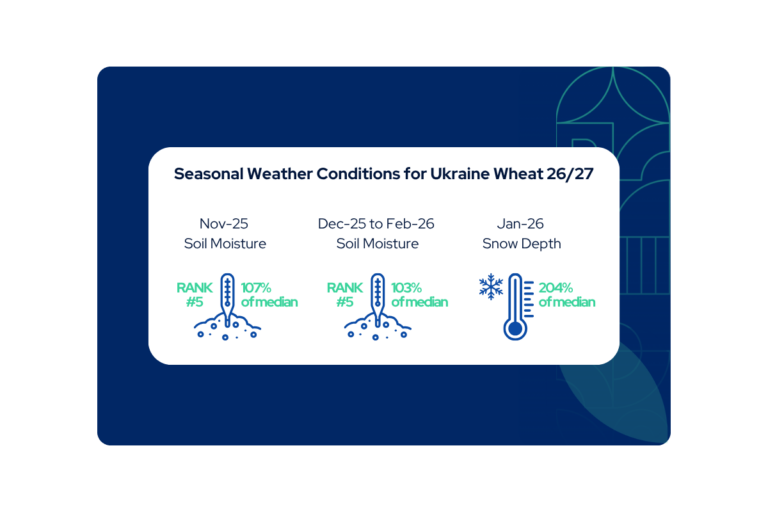
Overall, the combination of above-median soil moisture through the season and no significant impact from cold stress indicates that Ukraine’s wheat crop is tracking strong for the 2026/27 season.
Latest Ukraine Wheat Production Estimate
Octopusbot’s latest estimate for Ukraine wheat production in the 2026/27 season was revised lower compared with the previous update, driven by significantly below-median rainfall in March and emerging soil moisture deficits across key regions, particularly in Western provinces (rank #14 of the last 16 years).
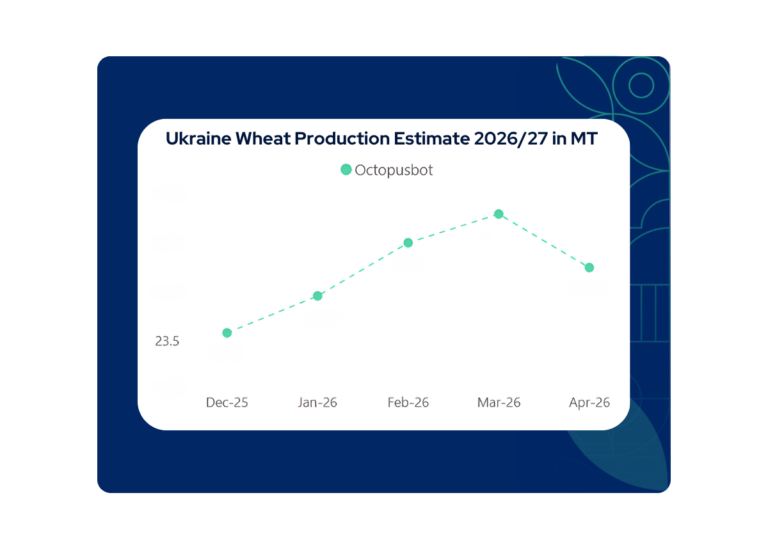
The key drivers impacting the latest production estimate are:
- Planted Area: Total area is down –1.8% compared to last year.
- Precipitation: March 2026 rainfall was significantly below median across all wheat provinces, reaching 33% of the median compared with 63% forecast.
- Soil Moisture: Soil moisture declined to below median nationally, falling from rank #3 to #11 of the last 16 years. Only Northern provinces remained above median.
- Precipitation Outlook: Rainfall is forecast above median from April through July (~136%) across wheat regions.
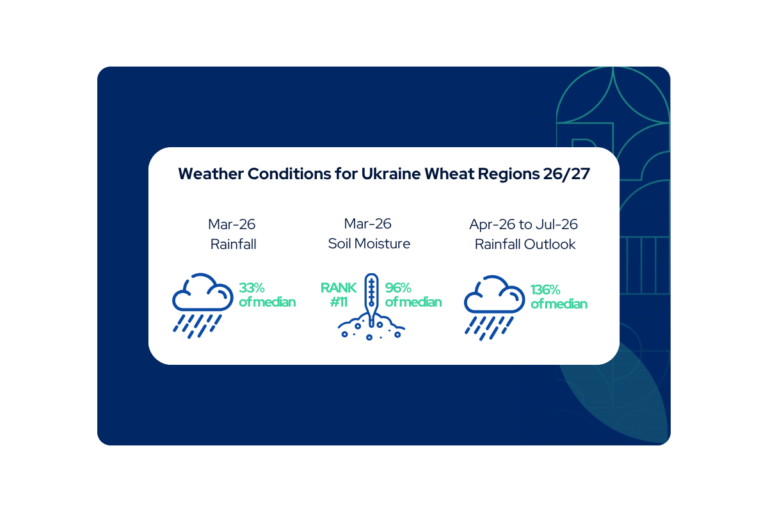
Despite the March dryness, wheat yields are projected higher than last season and above the five-year average, reaching the third highest level on record, supported by favourable early-season soil moisture and a positive seasonal outlook (136% of the median).
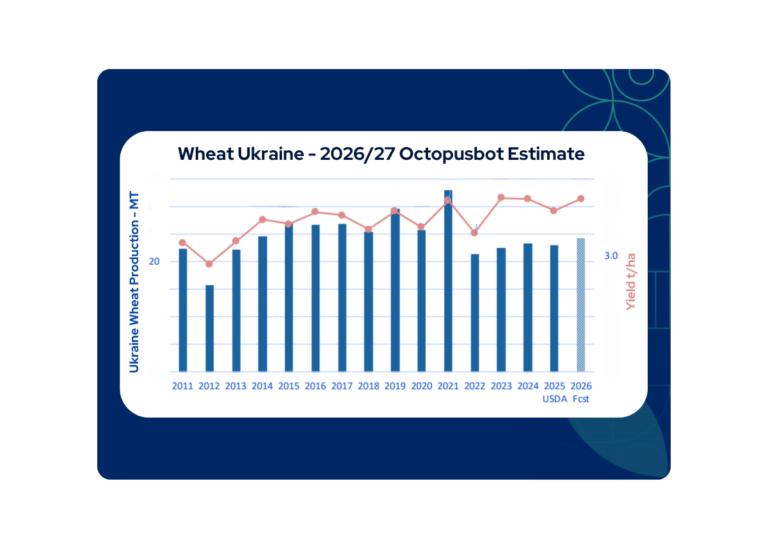
By quantifying the impact of favourable rainfall and soil moisture, seasonal forecast, and frost risks at the regional level, Octopusbot’s models project record wheat yield in Russia and a stronger crop in Ukraine, continuing a track record of strong forecast accuracy across Black Sea wheat markets, reinforced by satellite data.
Octopusbot Past Forecast Accuracy in Black Sea Wheat Markets
Octopusbot’s models have consistently demonstrated strong forecast accuracy across Black Sea wheat markets by quantifying the impact of weather conditions on production well ahead of traditional agencies. Octopusbot’s models combine hundreds of weather parameters with historical yields at the regional level to generate accurate forecasts for the season. These models also incorporate seasonal developments throughout the crop cycle to quantify yield-driven production shifts early and accurately.
In May 2024, Octopusbot successfully quantified the impact of the frost events on Russian wheat crop ahead of other agencies and within a 95% accuracy and 5 months before the final estimate, with a difference of 1.6% on the final estimate.
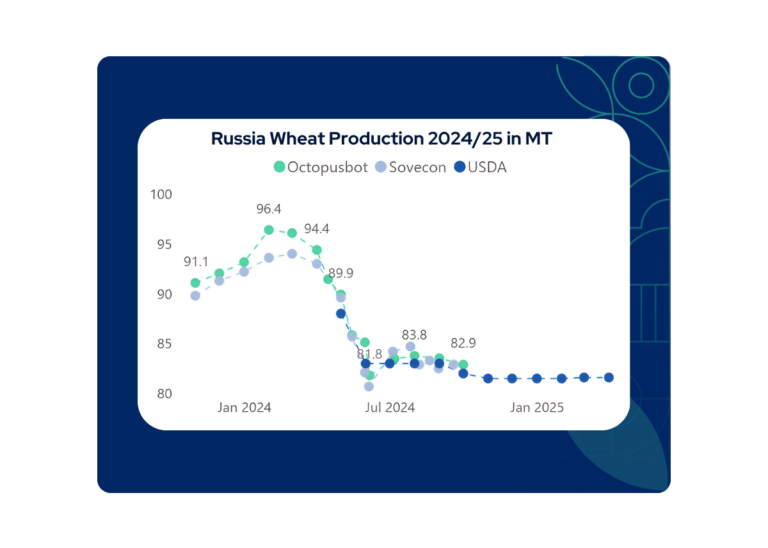
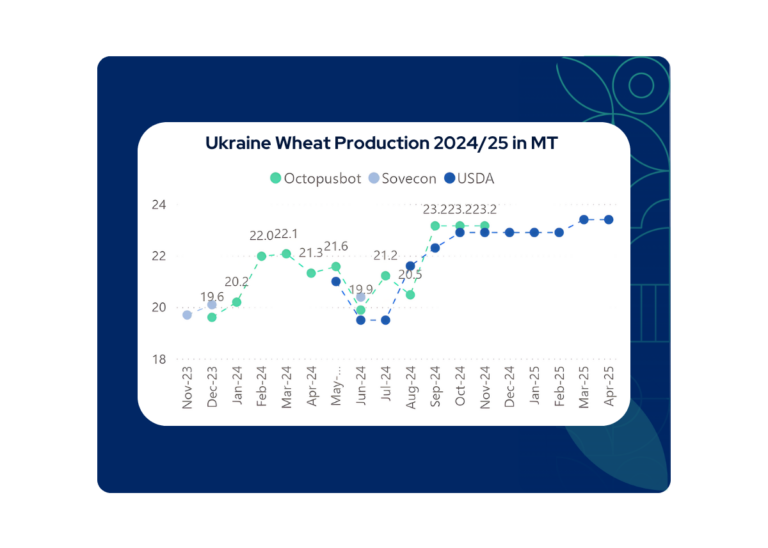
In February 2024, Octopusbot predicted the season’s production trend for Ukraine wheat within 95% accuracy range, 9 months before the final estimate and 7 months before USDA, with a difference of 0.9% on the final estimate.
Octopusbot works with grain traders, brokers, growers, and agribusinesses globally to quantify production risks and shifts early in the season, before they are reflected in official estimates or pricing. By removing market noise and bias and focusing on weather-driven yield outcomes, Octopusbot’s trusted forecasts help market participants plan ahead with confidence, trade at the right price, make confident, data-driven decisions, and gain an edge to improve income.
 For full, detailed AI forecasts on Black Sea wheat, corn, barley & more:
Comments are closed