
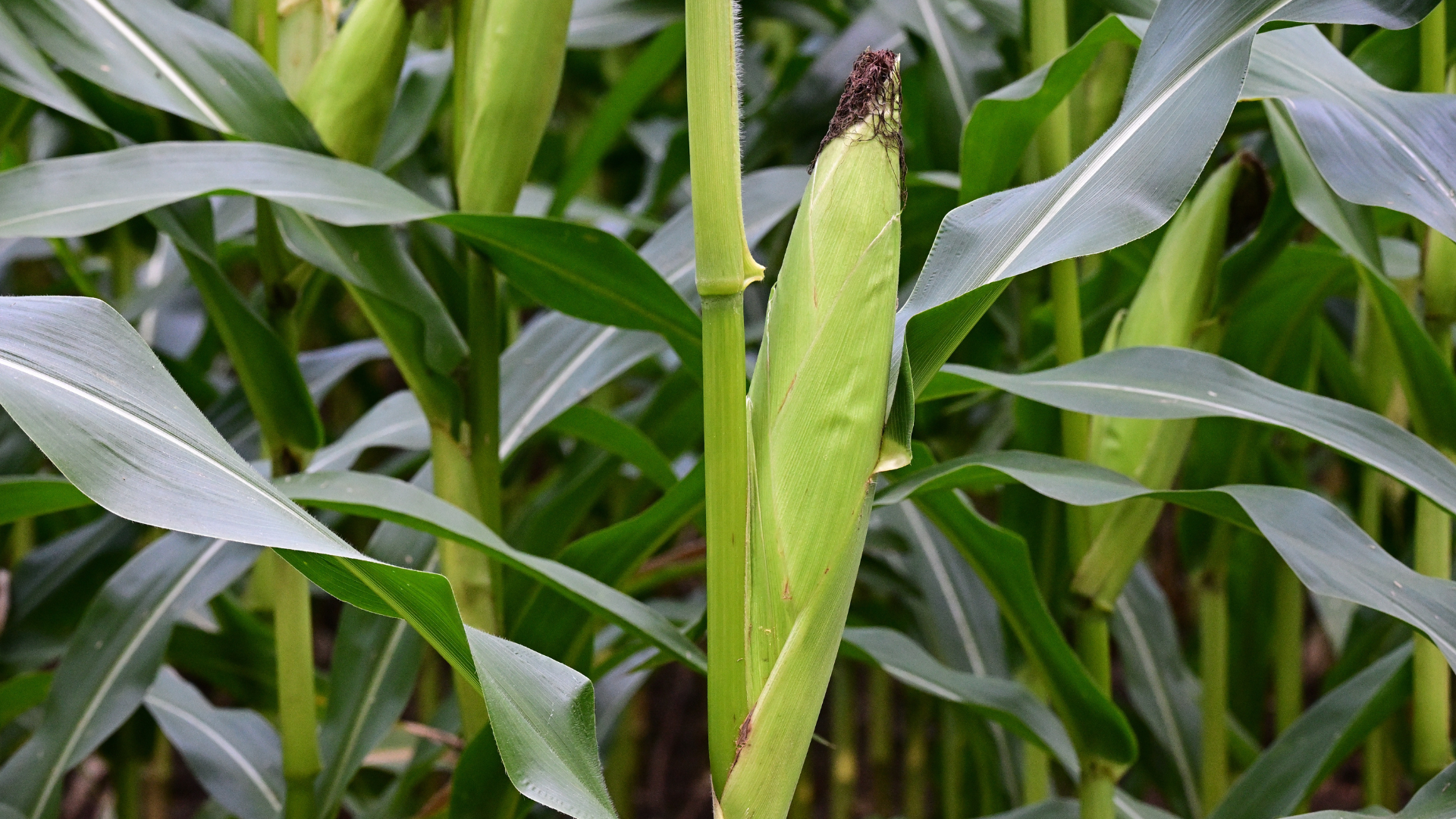
US corn condition ratings fell six points through July, matching 2022 as the sharpest July decline on record, as the crop moved through its most heat-sensitive stage.
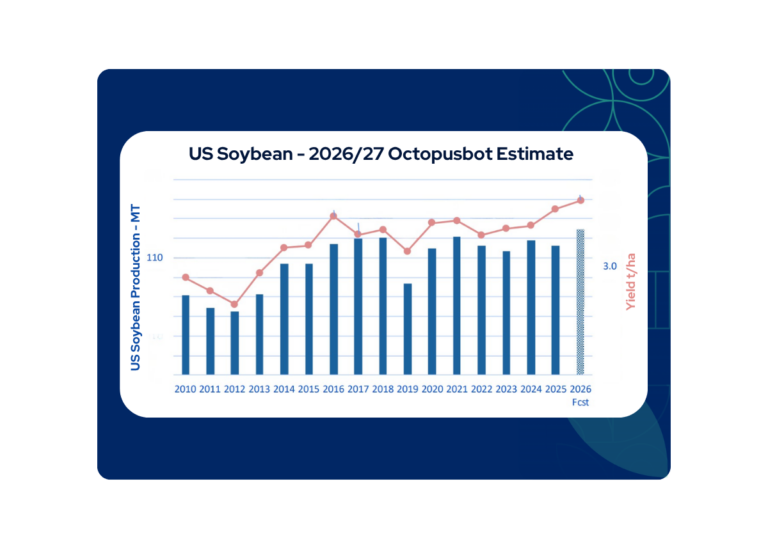
Octopusbot’s models quantified that heat events in July significantly reduced corn yields, but had a much smaller impact on soybean yields, which are tracking at the highest on record. Octopusbot’s satellite-based acreage classification quantifies planted area below USDA for both crops, with a wider gap for corn.
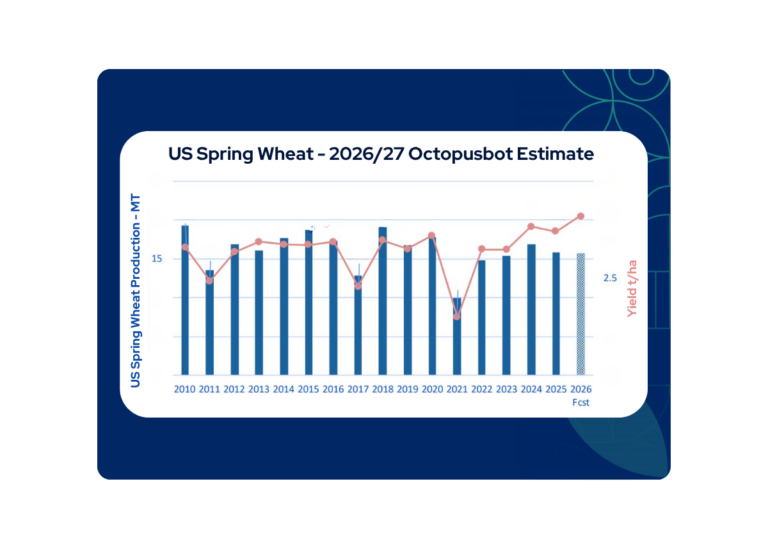
In Octopusbot’s latest spring wheat estimate, strong soil moisture across western counties, record yields in Montana, and a late but high-canopy crop in eastern counties, supported by satellite data, have pushed yields to the highest on record.
This blog examines how Octopusbot’s models quantify the impact of heat, rainfall, soil moisture and satellite data at the paddock level, along with acreage classification, to determine US corn, soybean and spring wheat production for season 2026/27.
What Does Paddock-Level Satellite Data Reveal for US Corn and Soybean Acreage?
Octopusbot’s latest acreage estimates for US corn and soybean is built from Sentinel-2 satellite imagery, classifying fields at the paddock-level across more than 15 million fields.
Nationally, Octopusbot’s estimate sits below the latest USDA estimate for corn (-2.9%) and slightly below USDA for soybeans (-0.5%). At the state level, Octopusbot’s estimate is compared against USDA’s June Acreage report, the most recent state-by-state figures published to date:
- Corn: Octopusbot’s estimate is lower than USDA in South Dakota and Nebraska, and broadly in line with USDA across the remaining states.
- Soybeans: Octopusbot’s estimate is lower than USDA in Minnesota and higher in Nebraska, and broadly in line with USDA across the remaining states.
Octopusbot’s Latest US Corn Production Estimate
Octopusbot‘s corn production estimate was revised sharply lower, down 3.6% from the previous update, driven mainly by July heat events and below-median soil moisture. The Corn Belt recorded around 3 more days above 32°C than normal through July, during pollination, the key yield-making period. However, with the crop now moving into grain fill under a wetter rainfall outlook (117% of the median), the yield risk remains low.
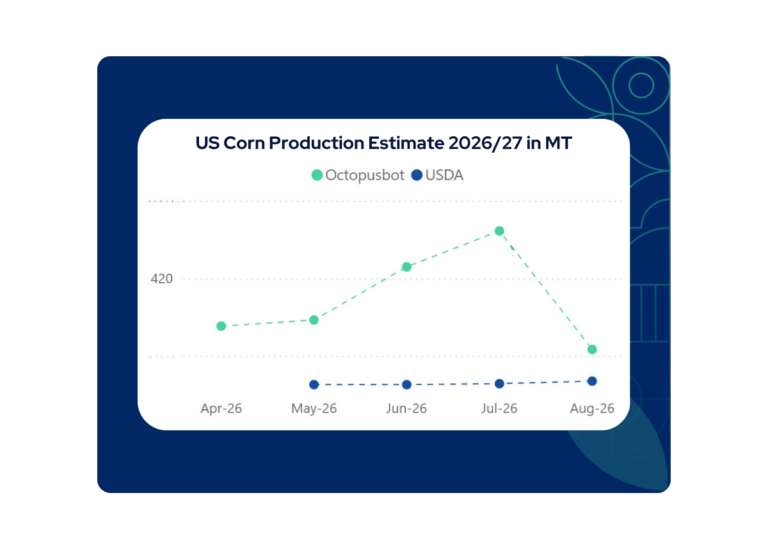
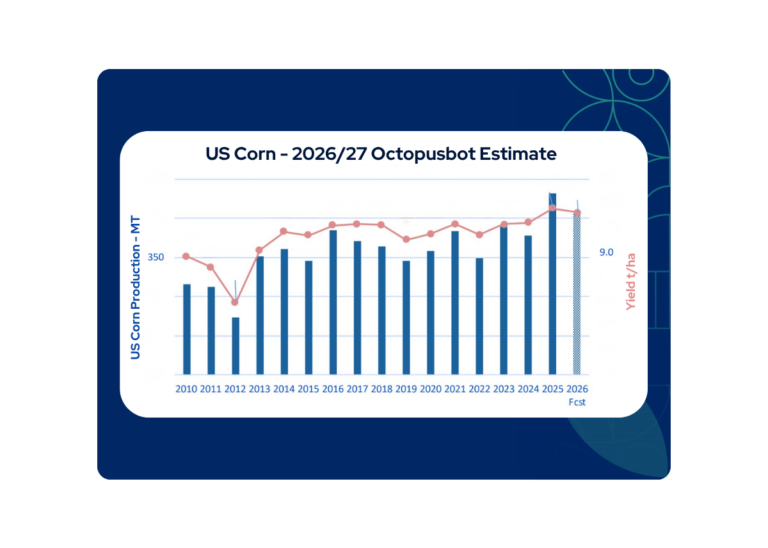
Corn yields are estimated at the second highest on record, supported by good June soil moisture in key states including Nebraska, Kansas and the Southern states (around 107% of median) and a wetter grain-fill outlook, reduced by July heat during pollination.
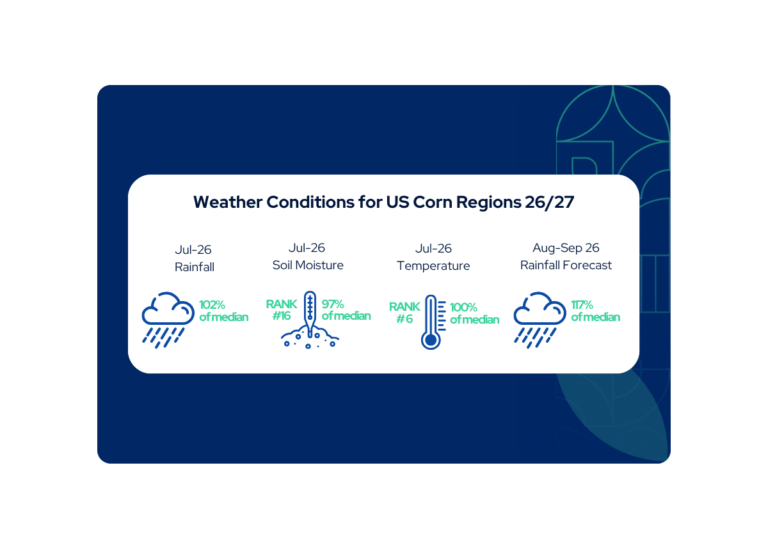
The key drivers impacting the latest corn production estimate are:
- Precipitation: July rainfall was 102% of median nationally, but with significant regional variation. Several states recorded well above median, including Minnesota (142%) and North Carolina (171%), while deficits persisted across the western belt, including North Dakota, Kansas and Nebraska.
- Soil Moisture: Below median in July at 97%, ranking #16 of the last 26 years.
- Temperatures: July recorded high temperatures (#6 highest of the last 26 years) across the Corn Belt, with 10.9 days above 32°C compared to a normal of 7.7 days.
- Precipitation Outlook: Positive rainfall is forecast for Aug–Sep (117% of median).
Did the July Heat Impact Soybeans?
July heat hit corn yields hard, but had a much smaller impact on soybeans. Soybean yields remain most sensitive August and September rainfall and that window is shaping up positively so far, with a favourable rainfall outlook from Aug-Sep (115% of the median). The Dakotas are the main exception, with North Dakota (77%) and South Dakota (80%) both forecast below median.
Soybean yields are estimated at the highest on record, supported by positive seasonal rainfall (108% of the median from Apr-Jul) and a favourable August-September outlook.
Octopusbot’s Latest Spring Wheat Estimates
July weather conditions were largely favourable for spring wheat, with strong soil moisture across Montana, Washington and Idaho (106% of median) supporting higher yields nationally.
Octopusbot’s latest estimate points to record yields for Montana, supported by satellite data indicators recording the highest peak NDVI since the Sentinel-2 series began in 2019, supporting the higher yield estimate. The Dakotas, particularly eastern counties, reached peak greenness behind normal, while western counties tracked in line with historical data.
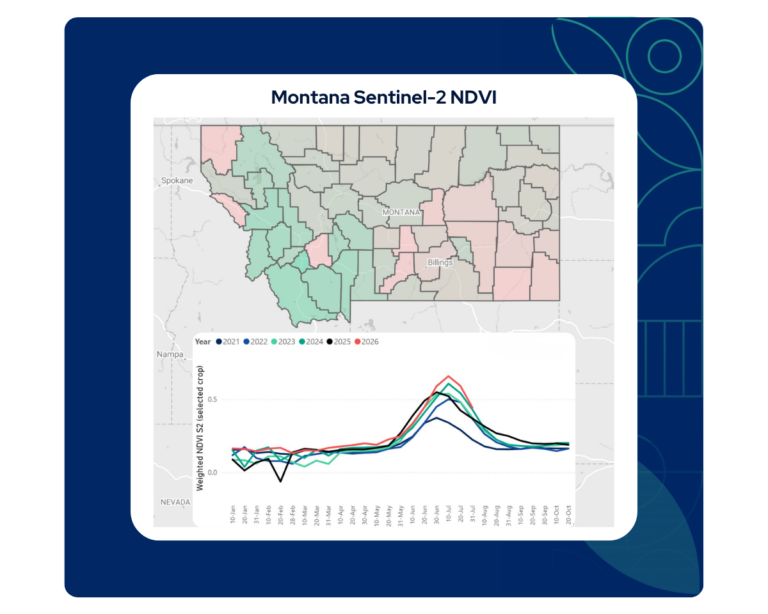
Octopusbot’s models estimate the highest spring wheat yield on record nationally, driven by strong soil moisture in the Northwest (106% of median) and a late, high-canopy crop in the eastern Dakotas.
However, planted area remains around 8% below last year, so production is estimated slightly lower than last year (-0.8%) but 8% above the 5-year average.
Octopusbot Past Forecast Accuracy
Octopusbot’s models have consistently demonstrated strong forecast accuracy across US grain and oilseed markets, combining hundreds of weather parameters with historical yields at the paddock level to quantify production shifts early and accurately, well ahead of official estimates.
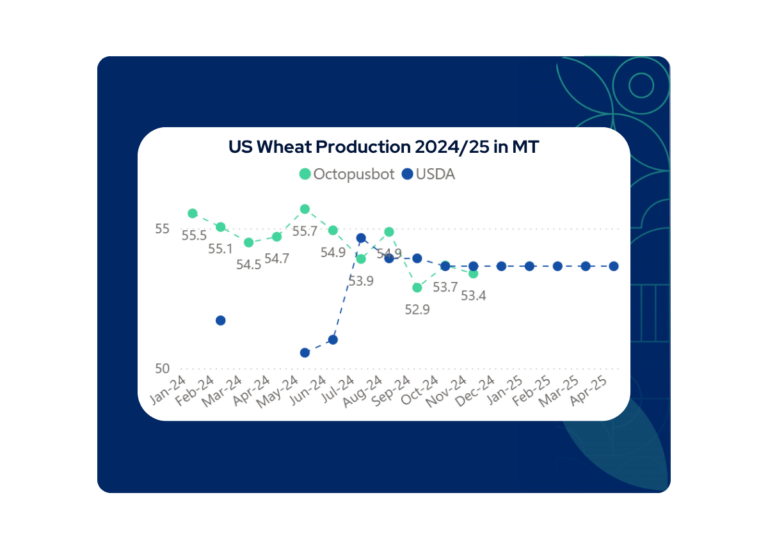
In January 2024, Octopusbot predicted the season’s production trend for US wheat within 95% accuracy range, 10 months before the final estimate and 6 months before USDA, with a difference of 0.6% on the final estimate.
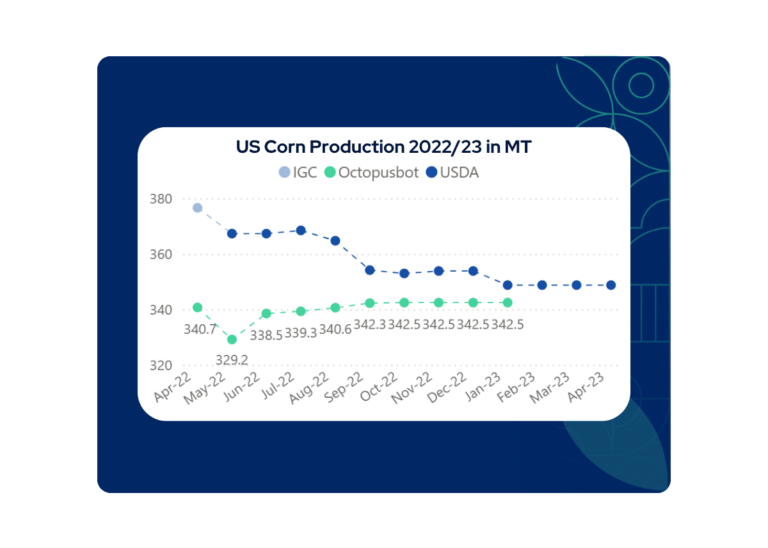
In April 2022, Octopusbot predicted that the season’s production would trend lower for US corn, 9 months ahead of USDA’s prediction, with a difference of only 1.8% on the final estimate.
Octopusbot empowers growers, grain traders, brokers, and agribusinesses globally with trusted forecasts that quantify production risks and shifts early in the season. By removing market noise and bias, Octopusbot’s trusted forecasts help market participants plan ahead with confidence, trade at the right price, make data-driven decisions, and gain an edge to improve income.
 For full, detailed AI forecasts on US wheat, corn, soybean & more:
Comments are closed