
Australia is heading toward a favourable winter crop season, with Octopusbot’s models forecasting higher wheat production since Dec-25 after quantifying a regionally concentrated impact from El Niño early in the season. Generally favourable soil moisture and growing conditions across most key regions have supported a stronger outlook across wheat, barley and canola, with USDA and ABARES now revising their September estimates much closer to Octopusbot’s levels.
Official Estimates Move Closer to Octopusbot in September
The largest changes this month have come from the official agencies, with substantial upward revisions across wheat, barley and canola as seasonal conditions developed closely in line with Octopusbot’s Best Accuracy weather forecast models, which had been factored into its crop outlook as early as Dec-25.
From early in the season, Octopusbot’s Best Accuracy rainfall forecasts were pointing to better rainfall than local forecasters and broader market concerns around El Niño. The models select the most accurate global forecaster for each region and month and quantified El Niño’s dry impact as being concentrated mainly in northern NSW and southern QLD. Southern NSW, SA and VIC were forecast to receive stronger seasonal rainfall and maintain favourable soil moisture, while WA remained largely unaffected by El Niño.
Throughout the season, actual rainfall came in close to or above Octopusbot’s forecasts, supporting the favourable wheat outlook quantified early in the season. In Mar-26, Octopusbot’s Best Accuracy Forecast predicted near-median rainfall at 98% of the median nationally from Apr–Aug, while BOM was signalling a substantially drier outlook at below 80% of the median over the same period.
That outlook progressively converted into positive growing conditions. May rainfall was 170% of the median vs. 92% forecast, followed by June at 180% vs. 174% forecast, while national soil moisture increased to 121% of the median by June, ranking #4 of the last 27 years. From June onwards, Octopusbot’s wheat production estimate increased progressively through July and August as favourable rainfall conversions and above-median soil moisture supported higher yields.
Most gains were seen in southern growing regions such as Wagga Wagga and Mildura, where rainfall averaged around 154% of the median from May to July, supporting higher yields and increasing production estimates by ~36% from May to August.
Favourable conditions continued into August, with rainfall at 156% of the median vs. 147% forecast and national soil moisture at 108% of the median, including above-median levels in NSW, SA and VIC. Frost risk also remains low across wheat regions at 0.9% probability.
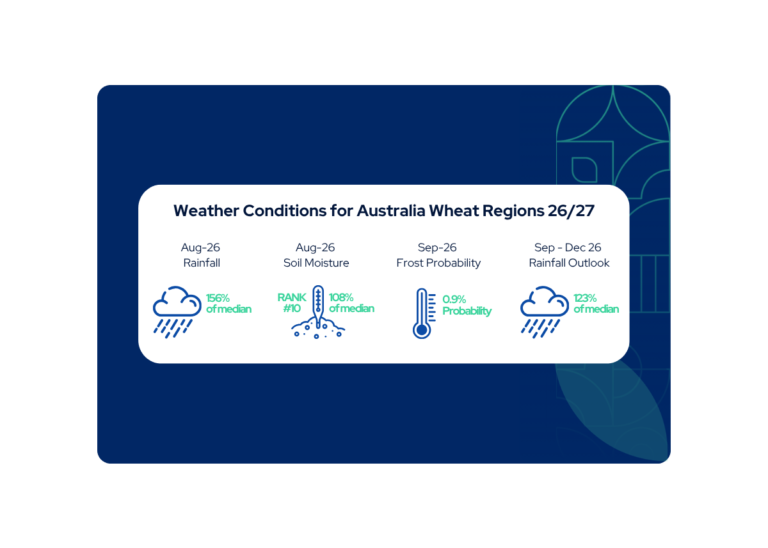
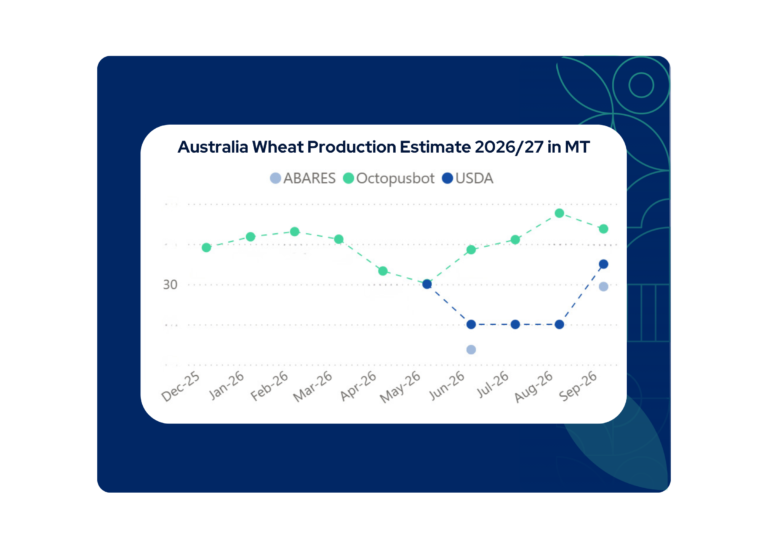
In the latest September update, USDA and ABARES increased their wheat estimates by 11% and 12% respectively, moving much closer to Octopusbot’s outlook. Octopusbot’s latest wheat production estimate was revised slightly lower, mainly in NSW and WA, as the September rainfall outlook across the two states reduced to 91% of the median from 138% forecast last month across the two states. The broader national outlook remains favourable, with September month-to-date plus forecast rainfall at 101% of the median, increasing to 116% in October and 137% from November–December.
In contrast, northern NSW and southern QLD continued to lag on emergence and moisture, keeping the El Niño impacts concentrated in those regions rather than across the broader wheat belt. Wheat planted area remained around 8% below last year, reflecting both weaker establishment in the drier northern regions and a crop-mix shift toward barley, a less fertiliser-intensive crop that became relatively more attractive amid high urea prices linked to the Middle East conflict.
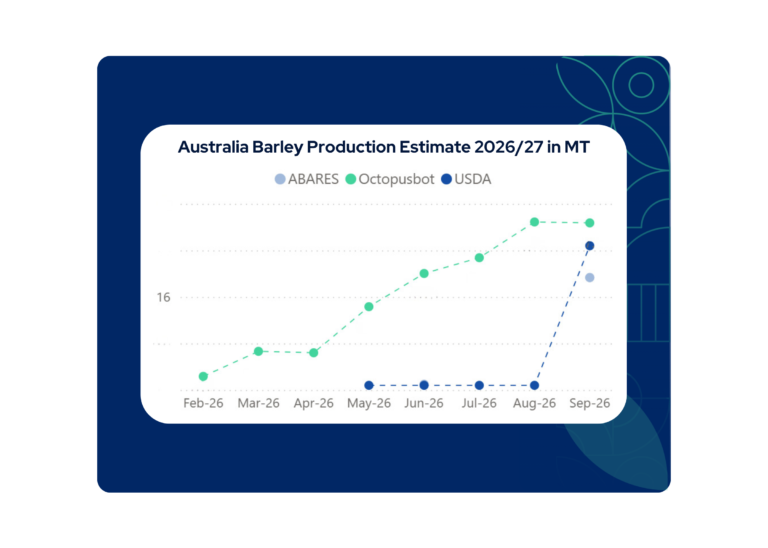
Barley saw the sharpest benchmark revisions, with USDA and ABARES substantially increasing their September estimates by 21% and 16% respectively, moving much closer to stronger crop outlook Octopusbot had been predicting since the start of the season, well ahead of official agencies. With barley concentrated mainly across southern growing regions, the crop has benefited from favourable seasonal rainfall and soil moisture across much of the south. Octopusbot’s latest estimate remained broadly unchanged, with production still tracking at a record level and national yields ranking second-highest on record.
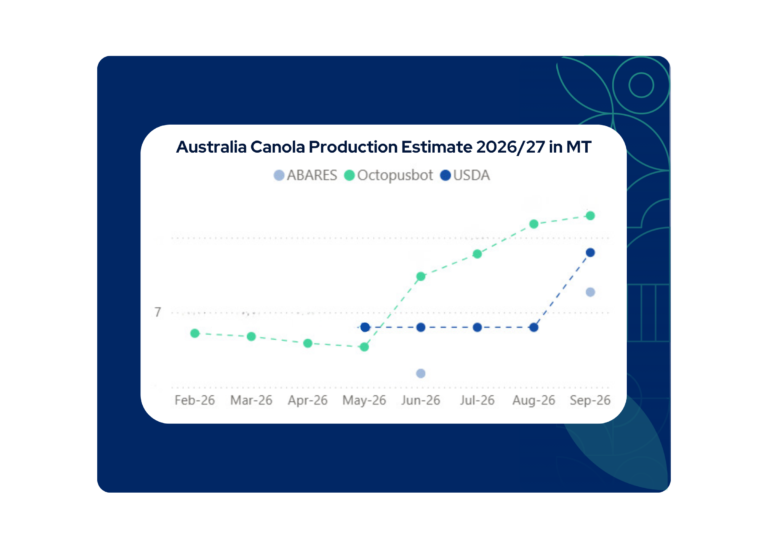
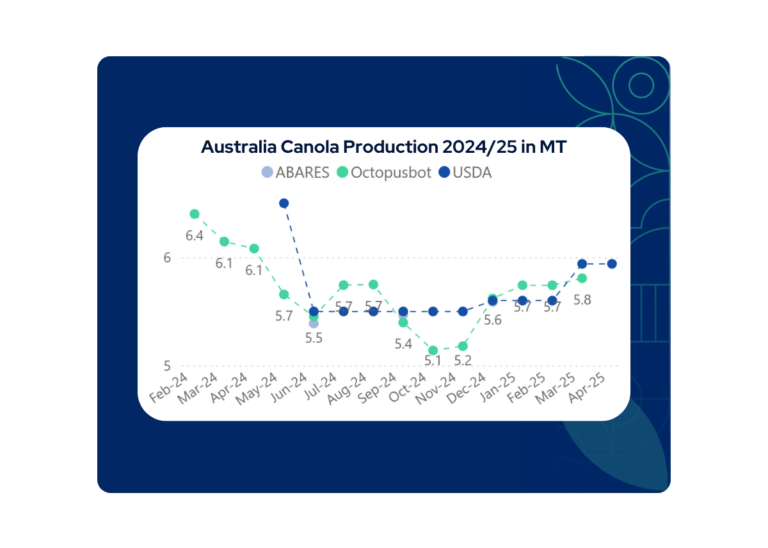
Canola followed the same trend, with Octopusbot predicting a stronger crop earlier in the season, well ahead of USDA and ABARES increasing their latest September estimates by 15% and 18% respectively. Favourable conditions across southern growing regions supported strong crop development, with flowering around Wagga Wagga and Wyalong advancing earlier than in previous seasons. Octopusbot’s latest estimate was revised slightly higher, mainly driven by higher area estimate in WA as satellite classification detected more canola flowering paddocks. Production is estimated to be the second highest on record, with yields ranking third highest.
Breaking Down the Wheat Gap with ABARES
Octopusbot’s latest wheat estimate remains approximately 10% above ABARES, with around 65% of the difference explained by higher area and 35% by higher yields.
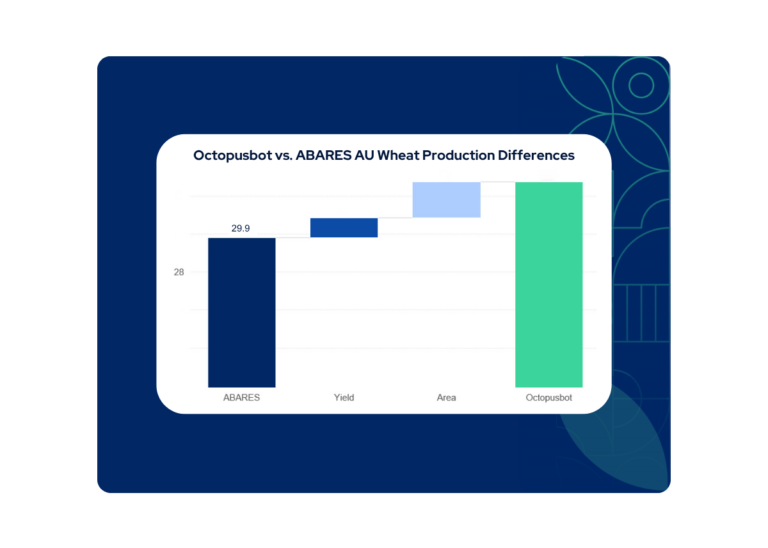
The gap varies by state. NSW is around 14% above ABARES, mainly driven by stronger yield potential across southern regions offsetting weaker conditions in the north. WA is tracking 10% above ABARES, supported by strong June rainfall (219% of the median) and emergence running well advanced.
Octopusbot Past Forecast Accuracy
Octopusbot’s models have consistently demonstrated strong forecast accuracy across Australian grain and oilseed markets, combining hundreds of weather parameters with historical yields at the regional level to quantify production shifts early and accurately, well ahead of official estimates.
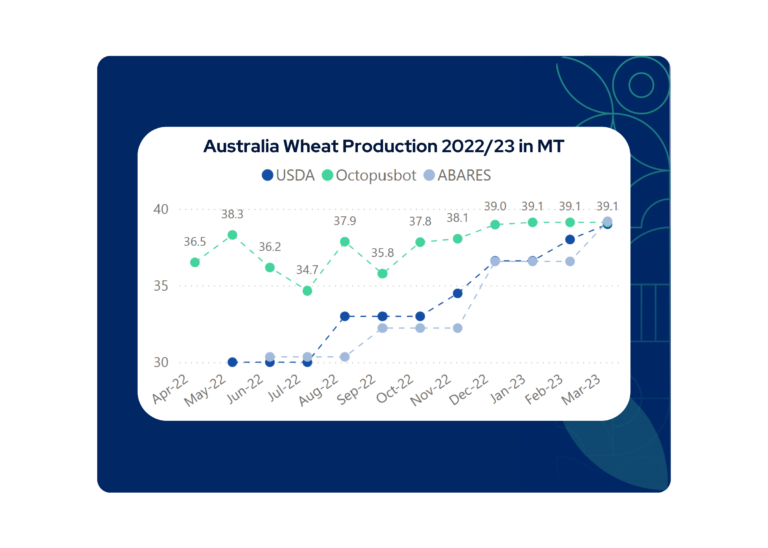
In May 2022, Octopusbot predicted the season’s production for Australia wheat within the 95% accuracy range, 10 months before the final estimate, 9 months before USDA and 10 months before ABARES, with a difference of 0.3% on the final estimate.
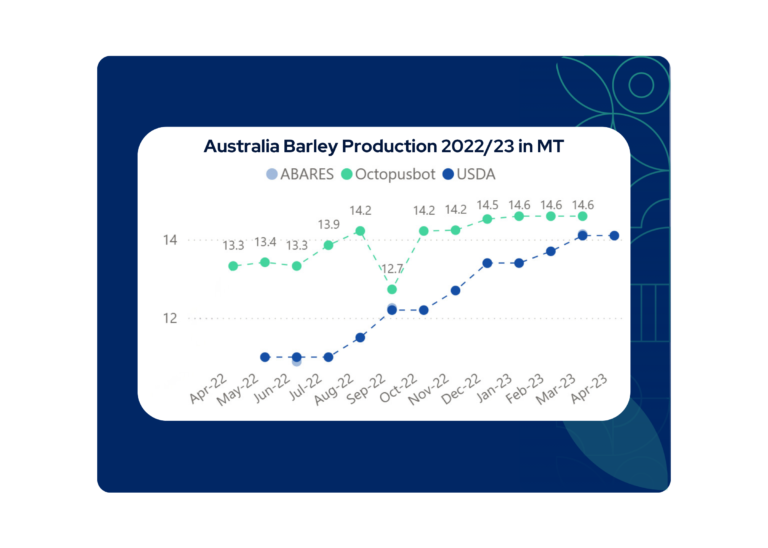
In April 2022, Octopusbot predicted the season’s production for Australia barley within the 95% accuracy range, 10 months before the final estimate, 7 months before USDA and 7 months before ABARES, with a difference of 3.5% on the final estimate.
In March 2024, Octopusbot predicted the season’s production trend for Australia canola within 95% accuracy range, 12 months before the final estimate and 3 months before the USDA and ABARES estimates, with a difference of 1.7% on the final estimate.
Octopusbot empowers growers, grain traders, brokers, and agribusinesses globally with trusted forecasts that quantify production risks and shifts early in the season. By removing market noise and bias, Octopusbot’s trusted forecasts help market participants plan ahead with confidence, trade at the right price, make data-driven decisions, and gain an edge to improve income.
 For full, detailed AI forecasts on Australia wheat, barley, canola & more:
Comments are closed