
El Niño is shaping a divided start to the 2026/27 South American season, bringing dry conditions to Brazil’s centre-west and a much wetter outlook across southern Brazil and Argentina. Planting is progressing ahead of last year, with Brazilian soybeans 9.4% planted by early October and Argentine corn 22% planted.
Octopusbot’s first production estimates for the season point to record Brazilian soybean and Argentine corn crops. Dry conditions in Mato Grosso are reducing soybean yield potential, while favourable rainfall across southern Brazil and Argentina supports stronger yields. Octopusbot’s models quantify the impact of El Niño on rainfall and soil moisture across South America at the provincial level from the start of the season.
How Is El Niño Shaping the South American Outlook?
El Niño typically brings drier conditions across Brazil’s centre-west and north, while supporting above-median rainfall across southern Brazil and Argentina during the spring and summer growing season. Octopusbot’s models quantify the 2026/27 season following this pattern, with the regional divide expected to strengthen from November as soybean and corn crops move from establishment into flowering.
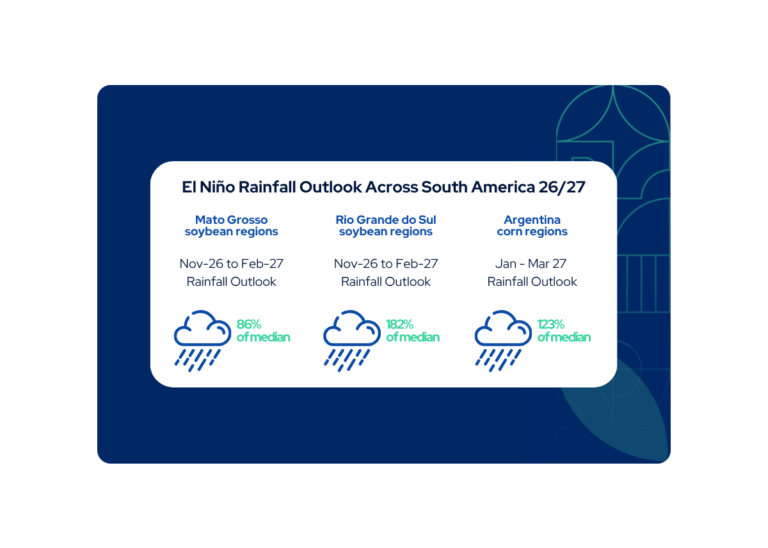
Brazil’s centre-west faces the driest conditions. In Mato Grosso, accounting for 26% of Brazil’s soybean planted area, September rainfall recorded 73% of the median and soil moisture was the fourth lowest of the last 27 years as planting began. Rainfall is forecast at 86% of the median from November to February, during early-growth and pod-fill stages reducing soybean yield potential.
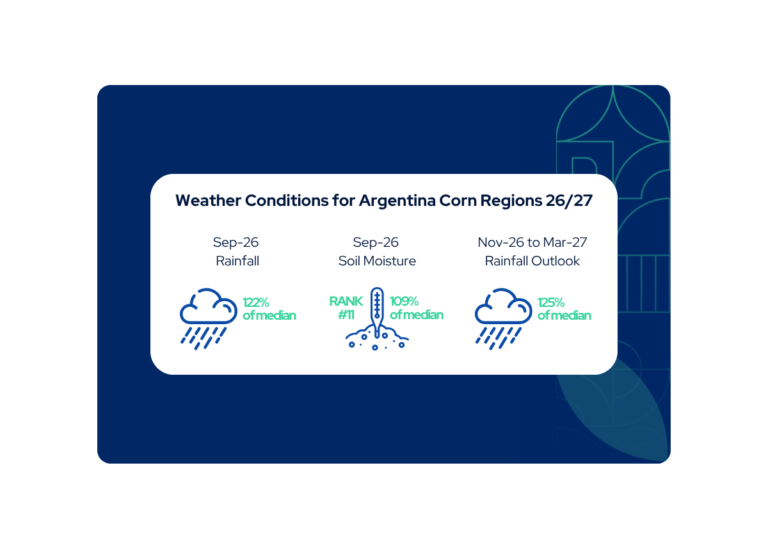
Southern Brazil and Argentina face a very wet summer. In Rio Grande do Sul, accounting for 14% of Brazil’s soybean planted area, rainfall is forecast at 182% of the median from November to February, among the wettest 10% of seasons, supporting favourable moisture through flowering and pod fill and higher soybean yields. In Argentina, soil moisture recorded 109% of the median in September as corn planting got underway. Rainfall across corn regions is forecast at 123% of the median from January to March, the third wettest outlook in 35 years, supporting strong yield potential through flowering and grain fill.
A Wet South Keeps Brazil Soybeans on Track for a Record Crop
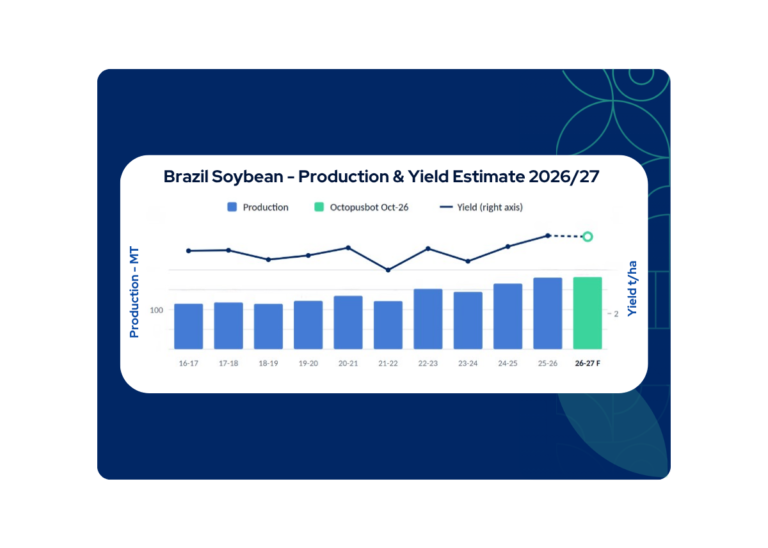
Octopusbot’s first 2026/27 estimate points to a record Brazilian soybean crop, with production 0.8% above last year. The estimate is broadly in line with CONAB and 2.3% below USDA.
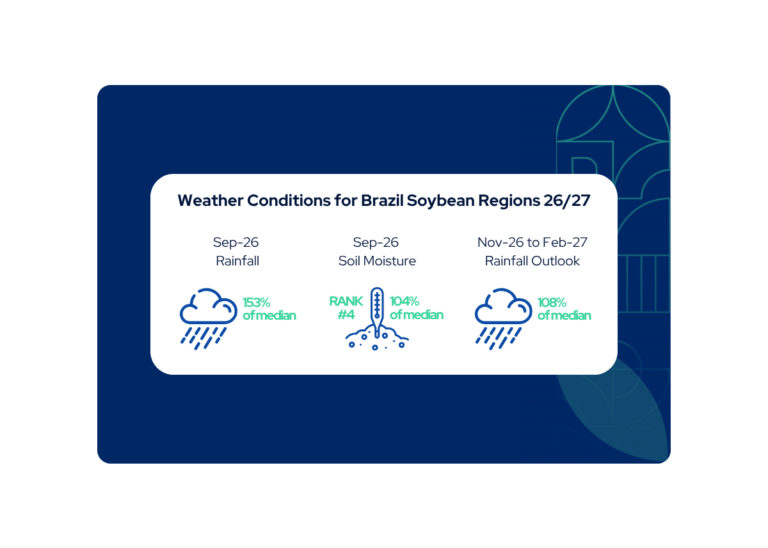
National conditions have started favourably. September rainfall across soybean regions reached 153% of the median, while soil moisture was 104% of the median, ranking fourth highest of the last 27 years. Rainfall from November to February is also forecast above median at 108%, although conditions vary significantly across key producing regions.
The regional differences are reflected in Octopusbot’s latest new season estimates. Compared with last year, Rio Grande do Sul is estimated to have the largest production increase, supported by its very wet summer outlook, while Mato Grosso records the largest reduction as below-median rainfall limits yield potential.
Brazilian soybean yields are estimated at the second-highest on record, only 0.5% below last year and 6.6% above the 5-year average. Favourable sowing moisture and the wet summer outlook across southern regions support strong yield potential, while dryness in Mato Grosso caps the yield potential. Planted area is estimated 1.4% above last year, supporting record production.
Wet Summer Outlook Supports Argentina Corn Toward Record Production
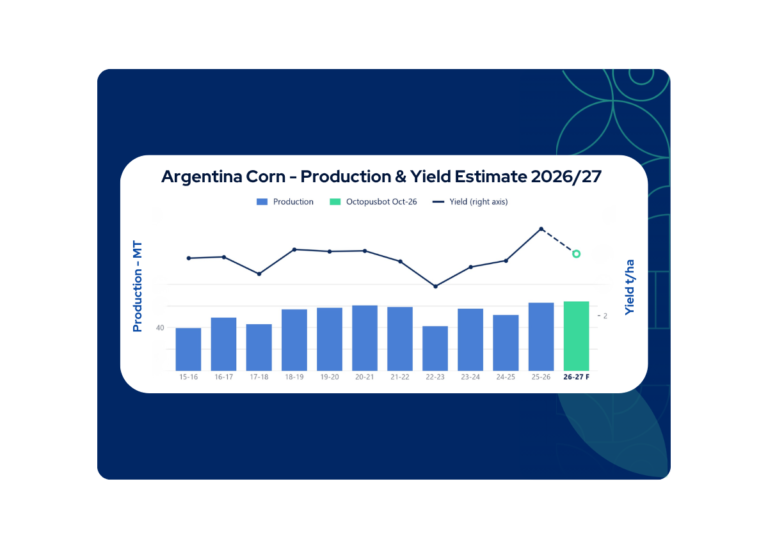
Octopusbot’s first 2026/27 estimate places Argentine corn production 1.6% above last season’s record. The estimate is 16.4% above USDA and 5.2% below Bolsa Rosario, with local estimates also pointing to a large crop while USDA remains considerably lower.
The season has started with strong moisture conditions. September rainfall across Argentina’s corn regions reached 122% of the median, while soil moisture was 109% of the median. Rainfall from November to March is forecast at 125% of the median, with the January to March outlook ranking the third wettest of the last 35 years.
This wetter period extends through flowering and grain fill, when corn yields are particularly sensitive to moisture availability. Santa Fe has one of the strongest rainfall outlooks across the core growing region, with January to March rainfall forecast at 132% of the median.
Argentine corn yields are estimated 19.4% above the 5-year average and slightly above Octopusbot’s yield estimate for last season, although below last season’s record yield reported in official estimates. Favourable sowing moisture and the wet outlook through flowering support the high yield estimates. Planted area is estimated 4% above last year, supporting record production.
Octopusbot Past Forecast Accuracy
Octopusbot’s models have consistently demonstrated strong forecast accuracy across South American grain and oilseed markets, combining hundreds of weather parameters with historical yields at the state and provincial level to quantify production shifts early and accurately, well ahead of official estimates.
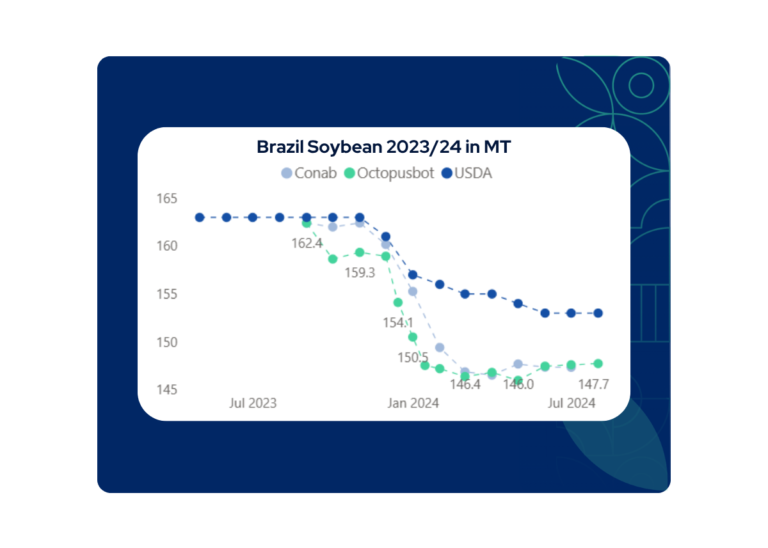
In December 2023, Octopusbot predicted the season’s production trend for Brazil soybean within 95% accuracy range, 8 months before the final estimate and 2 months before CONAB, with a difference of 0.3% on the final estimate.
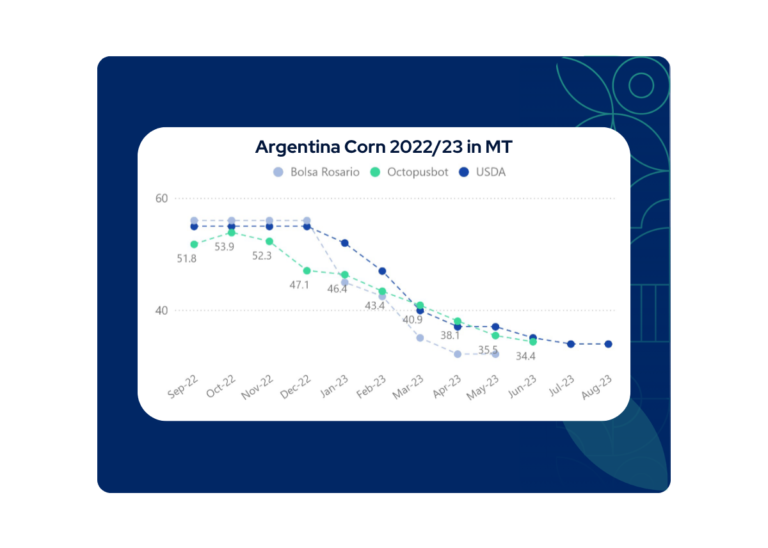
In May 2023, Octopusbot predicted the season’s production trend for Argentina corn within 95% accuracy range, 2 months before the final estimate, with a difference of 1.2% on the final estimate.
Octopusbot empowers growers, grain traders, brokers, and agribusinesses globally with trusted forecasts that quantify production risks and shifts early in the season. By removing market noise and bias, Octopusbot’s trusted forecasts help market participants plan ahead with confidence, trade at the right price, make data-driven decisions, and gain an edge to improve income.
 For full, detailed AI forecasts on South America wheat, barley, corn, soybean & more:
Comments are closed