
Excessive rainfall across China’s main wheat provinces through harvest raised concern over the 2026/27 crop, with attention turning to how much wheat China will need to buy next season.
Octopusbot’s AI models quantified the impact of this rainfall alongside every other weather parameter at the province level, across both wheat and corn. The models flagged a weak wheat crop, with yields lowest since 2018, driven by poor emergence and harvest rains. However, strong seasonal soil moisture and a positive rainfall outlook support the 3rd highest corn yields on record.
This blog examines how Octopusbot’s models quantify the impact of rainfall, soil moisture, and satellite data on China’s wheat and corn production, and what a weaker wheat crop means for China’s imports.
Octopusbot’s Latest China Wheat Production Estimate
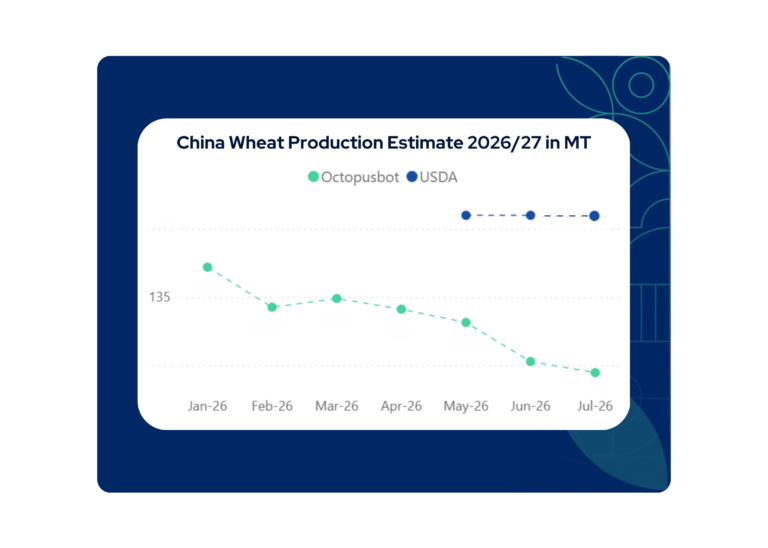
Octopusbot’s latest China wheat production estimate for the 2026/27 season was revised lower compared to the previous update, driven by prolonged wet conditions through the harvest window. Above-median rainfall is forecast in July across the key harvest provinces of Shandong (137% of median) and Anhui (152% of median), following already wet harvest conditions, with excessive May rainfall driving soil moisture up to 111% of median. Below-median June rainfall provided some relief, but the July forecast reduced yield potential through the remaining harvest
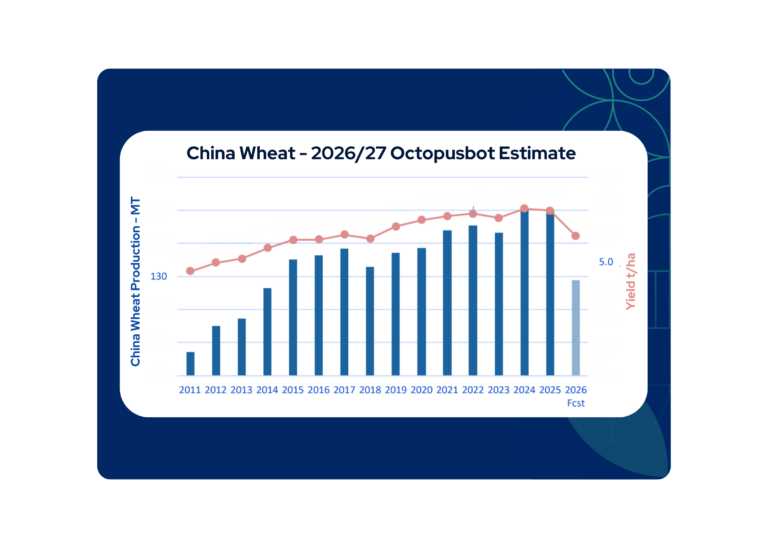
Wheat yields are estimated below last year, below the five-year average and the lowest since 2018. The weak yields reflect poor establishment after excessively wet sowing conditions (271% of the median rainfall), the weakest emergence in 25 years and severe harvest disruption from excessive May rainfall (169%).
The key drivers impacting the latest China wheat production estimate are:
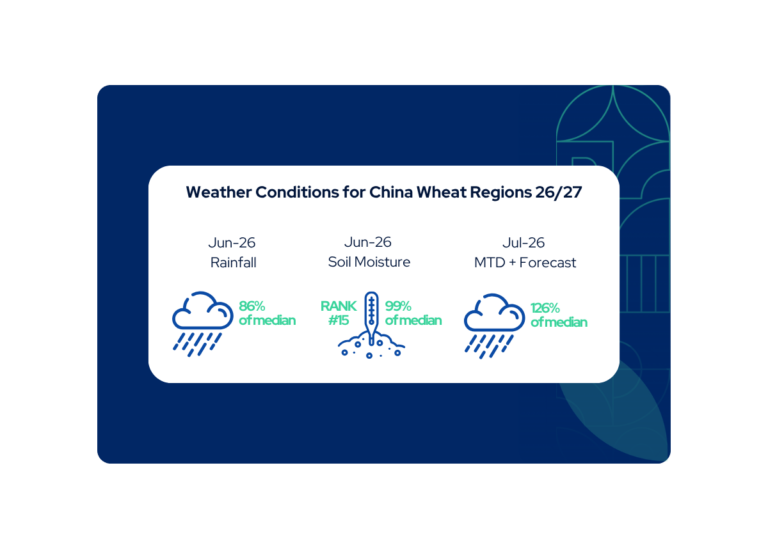
- Precipitation: June recorded below-median rainfall nationally (86% of median), while North and Northeast China recorded above-median rainfall (139%).
- Soil Moisture: Declined nationally to near-median levels, from rank #7 to #15 of the last 26 years, with deficits (<95%) in Gansu and Shandong.
- Precipitation Outlook: July month-to-date plus forecast indicates above-median rainfall nationally (126% of median).
Octopusbot’s Latest China Corn Production Estimate
Octopusbot’s latest China corn production estimate for the 2026/27 season was revised lower compared to the previous update, driven by above-median July rainfall forecast across North, Northeast and South-Central China (148% of median), which may cause waterlogging across these provinces, accounting for 66% of total area, and below-median June rainfall in Northwest China (76%) driving below-median soil moisture (95%).
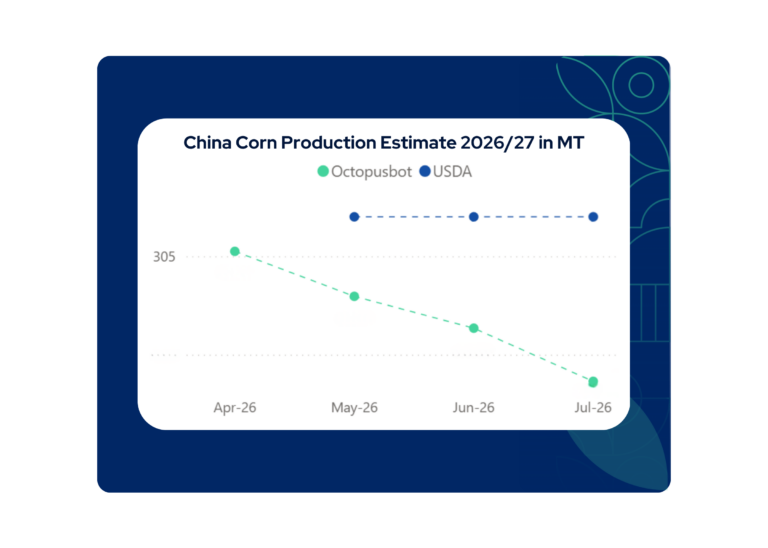
Corn yields are estimated below last year but above the five-year average and the 3rd highest on record, supported by generally favourable soil moisture to date (104% of the median) and a positive seasonal rainfall outlook, partly offset by early-season dryness in Northeast and Northwest China and excess rainfall in parts of the North China Plain.
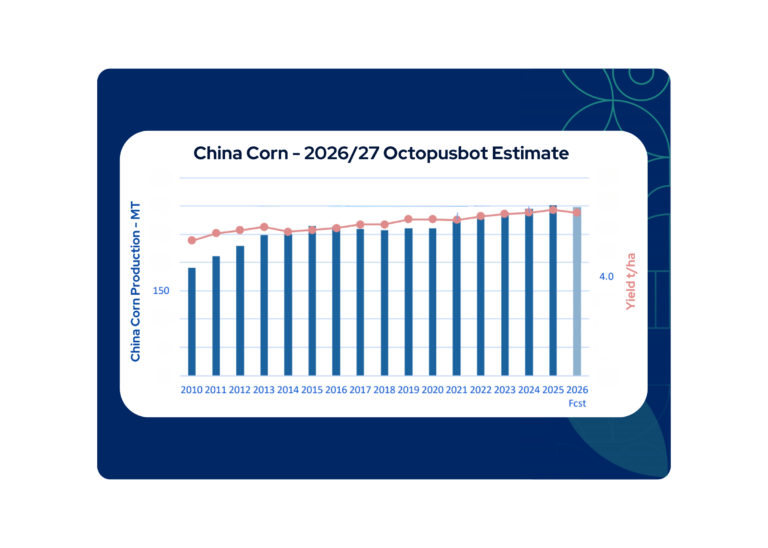
The key drivers impacting the latest China corn production estimate are:
- Planted Area: Estimated to be 1% higher than last year.
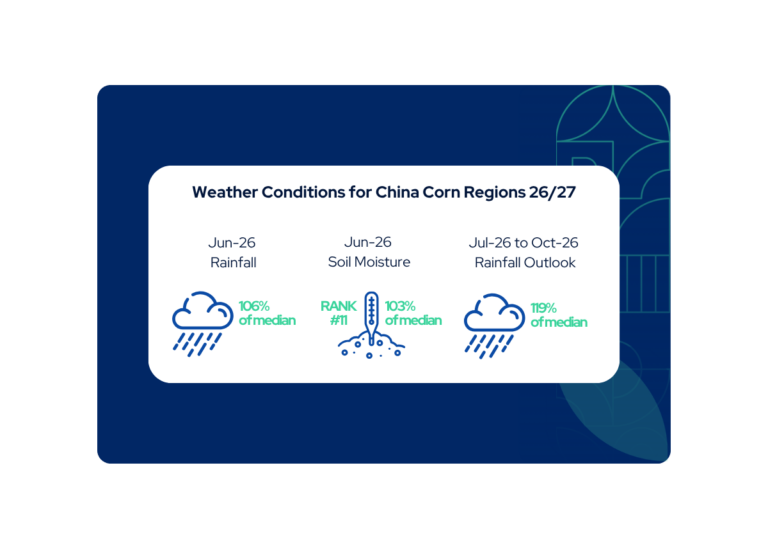
- Precipitation: June recorded above-median rainfall nationally (106% of median), with East, South Central and Northwest China recording below-median rainfall.
- Soil Moisture: Above median nationally (103% of median), with East and Northwest China below median (93%). Deficits were recorded in Gansu and Shandong (rank #24 and #20 of the last 24 years).
- Precipitation Outlook: Above-median rainfall is forecast from Jul–Oct 2026 (119%).
How much wheat will China buy in 2026/27?
Octopusbot projects China’s wheat imports ~17% higher than last season. Volumes remain well below the peak import seasons of 2022 and 2023, when China imported close to 14MT, but above the volumes recorded in recent seasons. Wheat is the only grain where Octopusbot’s import model outperforms a simple year-on-year assumption in back testing.
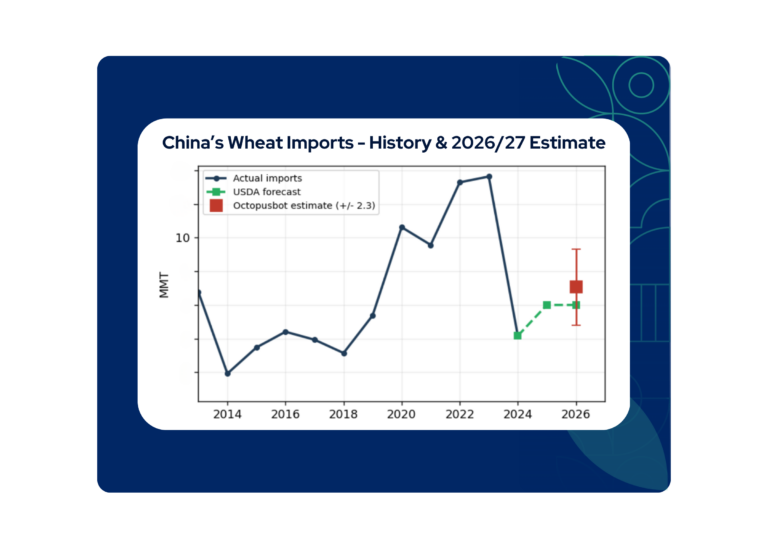
Octopusbot’s wheat import estimate reflects a weak domestic crop, caused by harvest rainfall, which supports higher imports. This is partially offset by lower feed demand. China’s breeding-pig herd is down approximately 8% from its 2023 peak, which reduces the volume of grain needed for animal feed, while more damaged wheat fed at home further lowers feed grain demand. The weak crop supports higher wheat imports, but lower demand caps them.
Octopusbot Past Forecast Accuracy
Octopusbot’s models have consistently demonstrated strong forecast accuracy across Asian grain and oilseed markets, combining hundreds of weather parameters with historical yields at the regional level to quantify production shifts early and accurately, well ahead of official estimates.
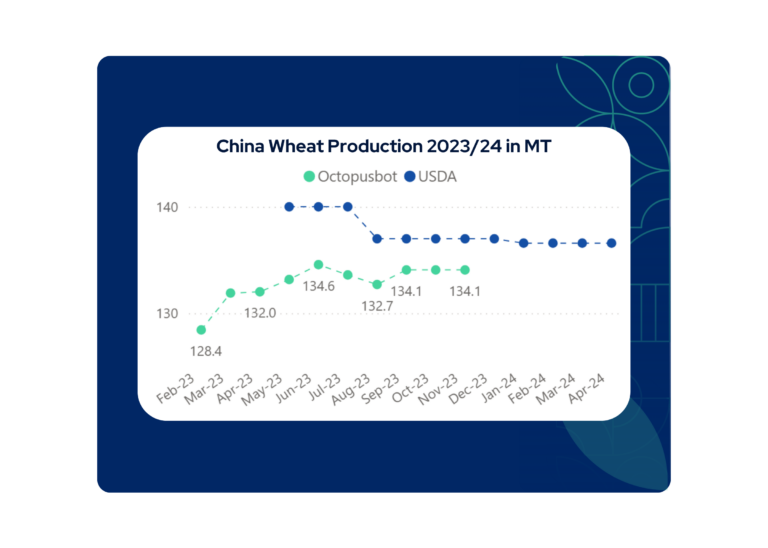
In March 2023, Octopusbot predicted the season’s production trend for China wheat within 95% accuracy range, 10 months before the final estimate and 2 months before USDA, with a difference of 1.8% on the final estimate.
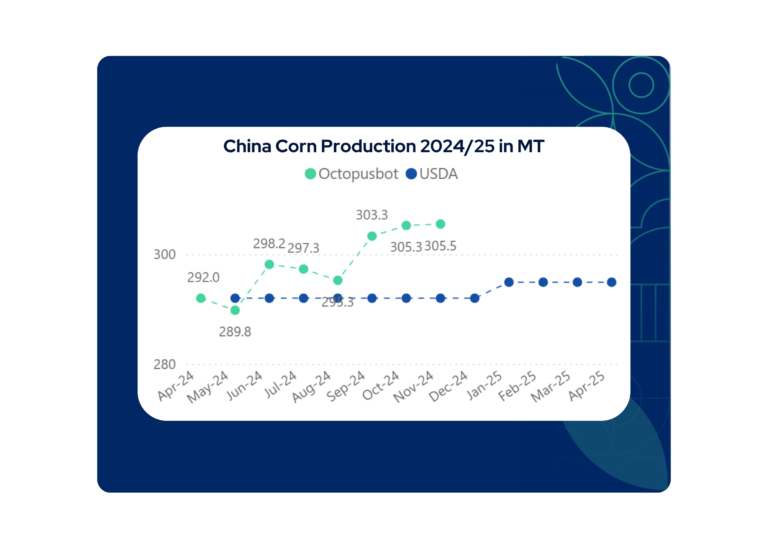
In April 2024, Octopusbot predicted the season’s production trend for China corn within 95% accuracy range, 7 months before the final estimate and 1 month before USDA, with a difference of 3.6% on the final estimate.
Octopusbot empowers growers, grain traders, brokers, and agribusinesses globally with trusted forecasts that quantify production risks and shifts early in the season. By removing market noise and bias, Octopusbot’s trusted forecasts help market participants plan ahead with confidence, trade at the right price, make data-driven decisions, and gain an edge to improve income.
 For full, detailed AI forecasts on China wheat, corn & more:
Comments are closed