
Octopusbot’s AI models are predicting a record Canadian canola crop for the 2026/27 season, creating bearish pressure on global canola prices as a record harvest from the world’s largest exporter adds to global supply.
Heat events in July typically pose the biggest risk to Canadian canola, as they impact the crop during critical grain filling. This was the case in 2021, when heat events in July damaged the crop, leading to one of the worst yields on record. This season, only minimal heat events were quantified, with a slight impact on yields. However, strong sowing conditions and generally favourable soil moisture across Saskatchewan, which constitutes 57% of the total area, are keeping the crop on track for a record high production and second highest yield on record.
This blog examines how Octopusbot’s AI models quantify the impact of heat events in July, rainfall, soil moisture and satellite data at the regional level to forecast a record Canadian canola crop for the 2026/27 season.
Octopusbot’s Latest Canada Canola Production Estimate
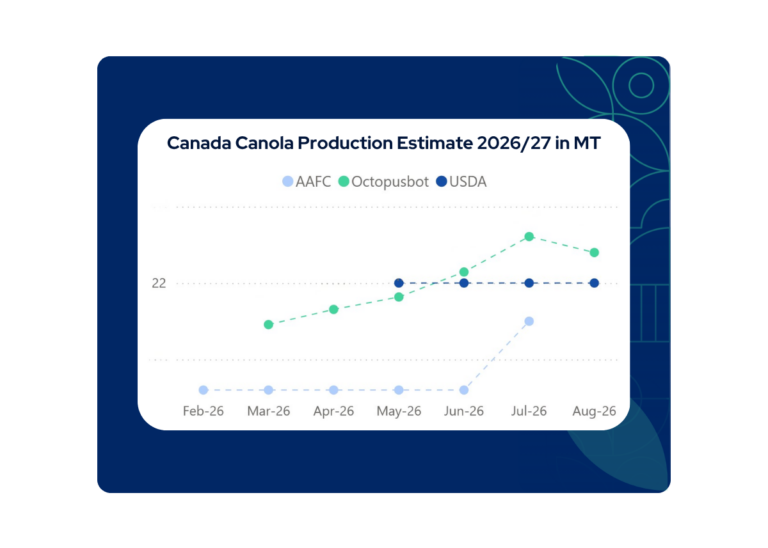
Octopusbot’s latest canola production estimate was revised 1.8% lower from the previous update, driven mainly by some heat events and below-median rainfall (77% of median) in July. Canola regions recorded 1.3 days above 32°C in July, well below the 5.8 days recorded in 2021. The crop still tracks strongly driven by generally favourable seasonal rainfall and soil moisture across major cropping regions, with Octopusbot’s latest estimate sitting at 8.6% above AAFC and 3.6% above USDA.
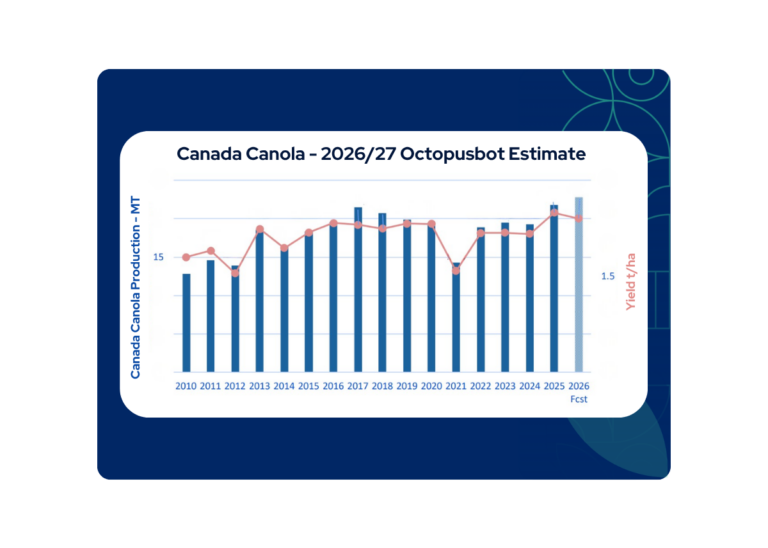
Canada’s canola yields are predicted to be lower than last year but above the 5-year average and the second highest on record, driven by one of the best sowing conditions in recent seasons with 106% of median soil moisture in June and above-median soil moisture across Saskatchewan till date.
With planted area up 8.4% year-on-year and yields tracking near record levels, Octopusbot’s models estimate Canada’s canola production at a record high for the 2026/27 season.
The key drivers impacting the latest canola production estimate are:
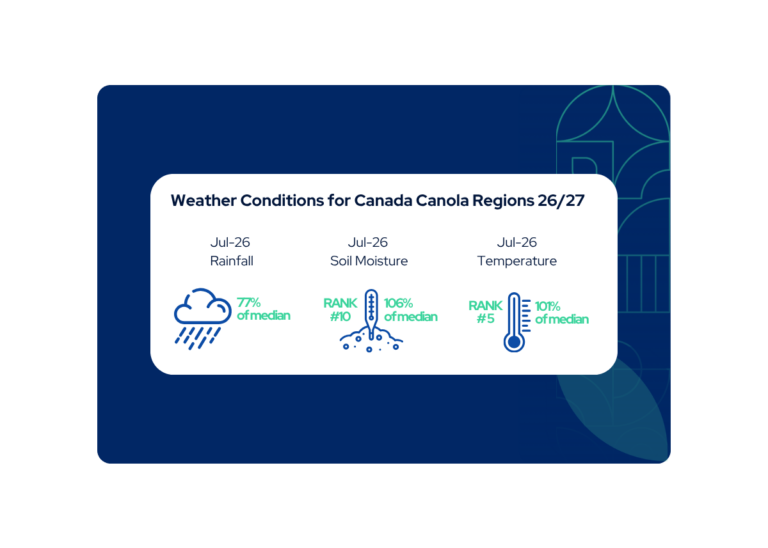
- Precipitation: July rainfall was below-forecast (77% vs. 93% forecast) across canola regions.
- Soil Moisture: Above median in July at 106%, ranking #10 of the last 24 years.
- Temperatures: July recorded high temperatures (#5 highest of the last 24 years) across canola regions, with 1.3 days above 32°C.
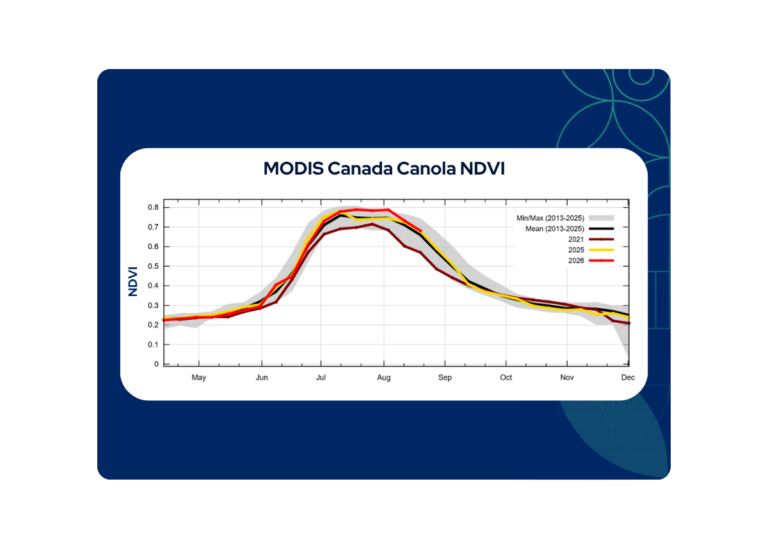
Octopusbot’s satellite data further supports the record production estimate, as supported by seasonal biomass signals illustrated in the chart below. The peak of the NDVI for the current season (red line) is tracking above the historical mean (black line), indicating a record crop, a sharp contrast with 2021 season, when NDVI tracked below the historical mean, consistent with that year’s heat-driven crop damage.
Octopusbot Past Forecast Accuracy
Octopusbot’s models have consistently demonstrated strong forecast accuracy across Canadian grain and oilseed markets, combining hundreds of weather parameters with historical yields at the regional level to quantify production shifts early and accurately, well ahead of official estimates.
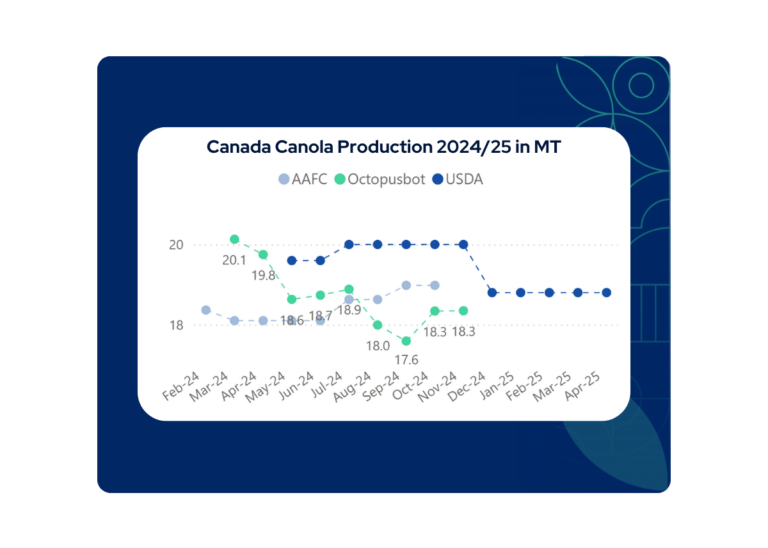
In April 2024, Octopusbot predicted within 95% accuracy range, that the season’s production for Canada canola would trend lower than the USDA, 7 months before the final estimate and 1 month before USDA, with a difference of 2.7% on the final estimate.
Octopusbot empowers growers, grain traders, brokers, and agribusinesses globally with trusted forecasts that quantify production risks and shifts early in the season. By removing market noise and bias, Octopusbot’s trusted forecasts help market participants plan ahead with confidence, trade at the right price, make data-driven decisions, and gain an edge to improve income.
 For full, detailed AI forecasts on Canada wheat, barley, canola & more:
Comments are closed