
June’s heat events across Europe raised concern over the 2026/27 wheat crop, with record temperatures across several producing countries drawing attention to yield potential heading into harvest.
Octopusbot’s AI models quantified the impact of these heat events alongside every other weather parameter at the regional level. While the heat continues to weigh on corn yield potential, Octopusbot’s models did not flag a measurable impact on wheat. Octopusbot’s latest estimate sits below COCERAL and last season, with weaker soft wheat yields but the highest durum yields on record.
This blog examines how Octopusbot’s models quantify the impact of rainfall, soil moisture, temperature events and the seasonal forecast on Europe’s wheat production, and which producers were most affected by the June heat.
Which major producers were hit by the June heat?
France, the largest EU-27 producer, drew the most market concern ahead of harvest. June brought high temperatures, with the highest number of days above 35°C on record. However, these heat events occurred after grain filling towards the end of June, with no impact on yield. Therefore, Octopusbot revised French production higher month on month (+2.6%), however, it remains 7% below last year driven by dry April conditions.
Germany, Spain, Italy and Bulgaria recorded downward revisions. Germany and Italy recorded the highest number of days above 35°C on record, with Spain 4th highest. Octopusbot’s models reduced yields across these producers because the crop has been under stress since April with poor mid-season rainfall (~75% of the median) and soil moisture deficits, followed by the June heat events causing prolonged stress.
Octopusbot remains below COCERAL in several key producers, including Spain, Poland, Hungary, Lithuania and Germany. In these countries, the gap reflects the mid-season dryness that reduced yield potential during critical growth stages.
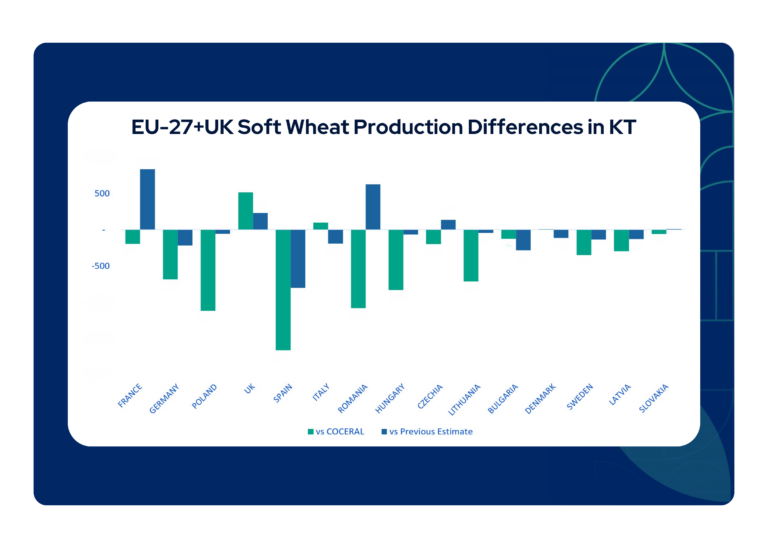
In Romania, Octopusbot’s estimate sits below COCERAL. The same occurred last season, when Octopusbot quantified a weaker crop, tied to dry conditions during crucial growth stages, while official estimates remained high. For season 2026/27, Octopusbot projects Romanian soft wheat production lower than last year and close to the 5-year average.
Octopusbot’s Latest Europe Wheat Production Estimate
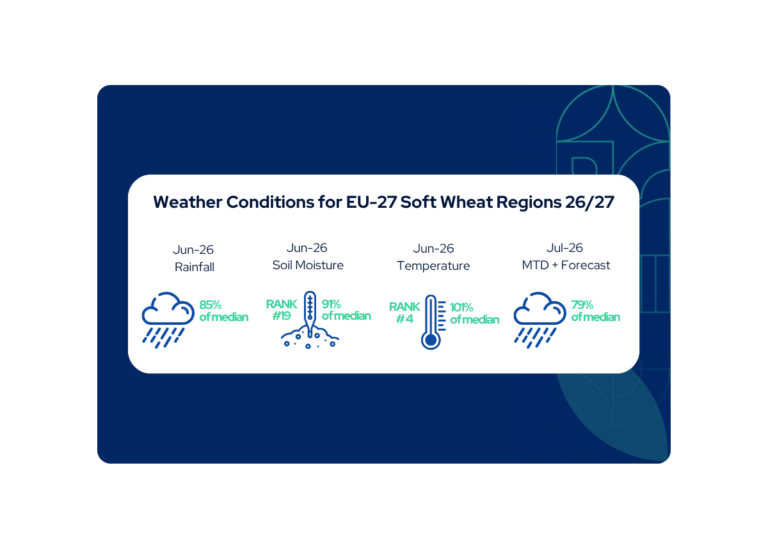
Octopusbot’s latest EU-27 soft wheat production estimate for the 2026/27 season was revised lower compared to the previous update, driven by reduced area, below-forecast June rainfall (85% of the median), high temperatures in key producers and soil moisture deficits across the central producing belt. Reductions were concentrated in Spain, Bulgaria, Germany and Italy, partially offset by increases in France and Romania.
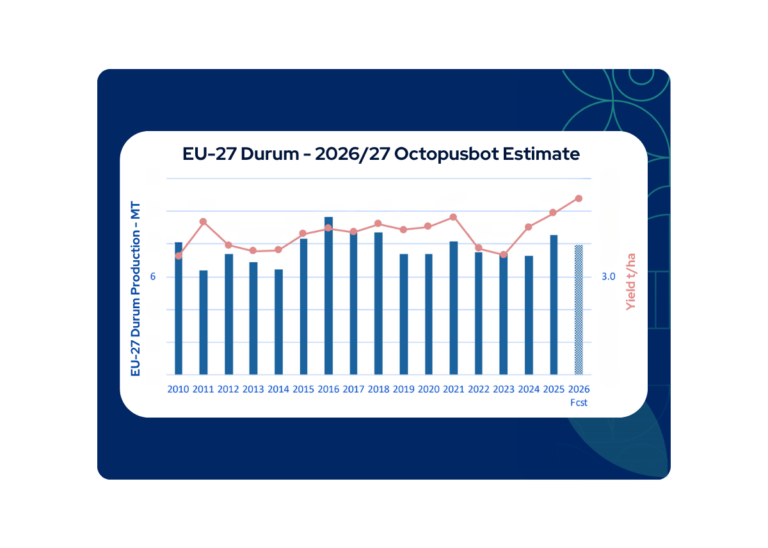
Octopusbot’s latest durum estimate was also revised lower compared to the previous estimate by Octopusbot, driven by reduced area and below-forecast June rainfall (60% of the median), with reductions concentrated in Italy, Bulgaria and Spain.
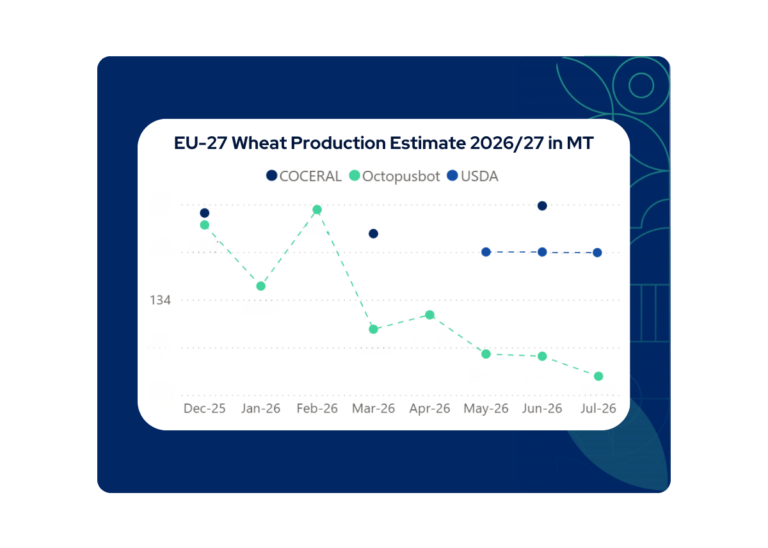
Octopusbot’s total EU-27 wheat estimate sits approximately 5% below COCERAL, 4% below USDA and 10% below last season. The on-ground seasonal developments and their impact on yields are not yet fully reflected in official estimates.
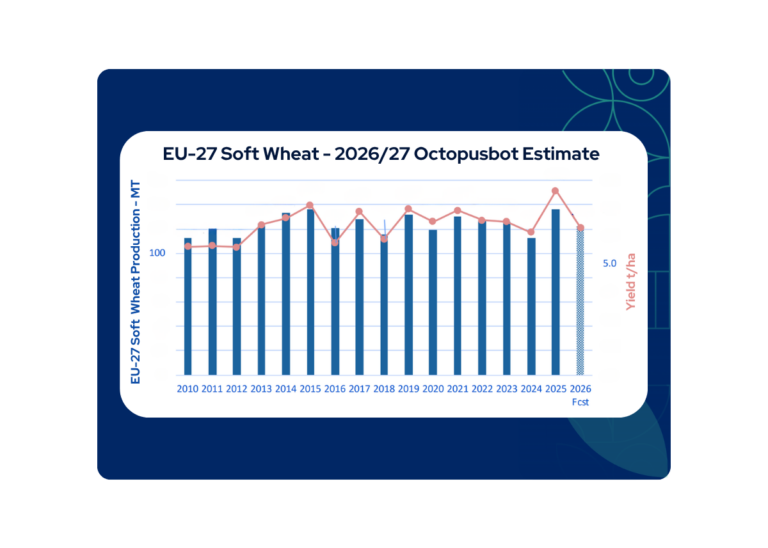
Soft wheat yields are estimated below last year and below the five-year average, mainly driven by April soil moisture deficits in Poland and Spain (ranked #24 driest of last 24 years) and high June temperatures.
The key drivers impacting the latest soft wheat production estimate are:
- Planted Area: Planted area is estimated slightly higher than last year (+0.5%).
- Precipitation: June recorded below-median and below-forecast rainfall (85% vs. 108% forecast).
- Soil Moisture: Below median across Europe at 91%, ranking #19 of the last 24 years. Severe deficits (<80% of the median) persist in France, Spain and Italy.
- Temperatures: June recorded above-median temperatures, ranking #4 highest of the last 24 years. France, Germany, Poland and Italy recorded the highest number of days above 35°C on record.
- Precipitation Outlook: July month-to-date plus forecast indicates below median rainfall across Europe, at 79% of median.
Durum yields are estimated to be the highest on record, supported by strong early-season rainfall (140%) and favourable soil moisture (~105%) in key producers such as Italy, Greece and Spain.
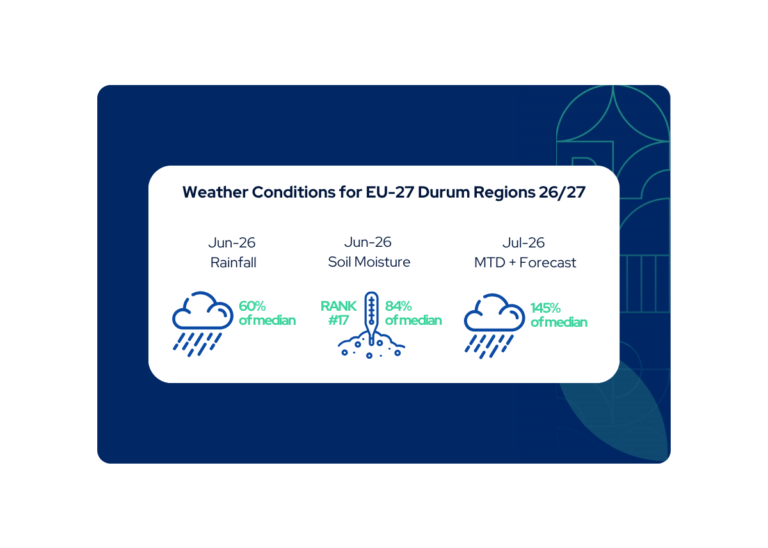
The key drivers impacting the latest durum wheat production estimate are:
- Planted Area: Durum planted area is estimated lower than last year (−9%).
- Precipitation: June recorded below-forecast rainfall (60% vs. 90% forecast).
- Soil Moisture: Below median (84%), with severe deficits in France and Austria (rank #25 driest of last 25 years).
- Precipitation Outlook: July month-to-date plus forecast indicates above median rainfall (145% of the median).
Octopusbot Past Forecast Accuracy
Octopusbot’s models have consistently demonstrated strong forecast accuracy across European grain and oilseed markets, combining hundreds of weather parameters with historical yields at the regional level to quantify production shifts early and accurately, well ahead of official estimates.
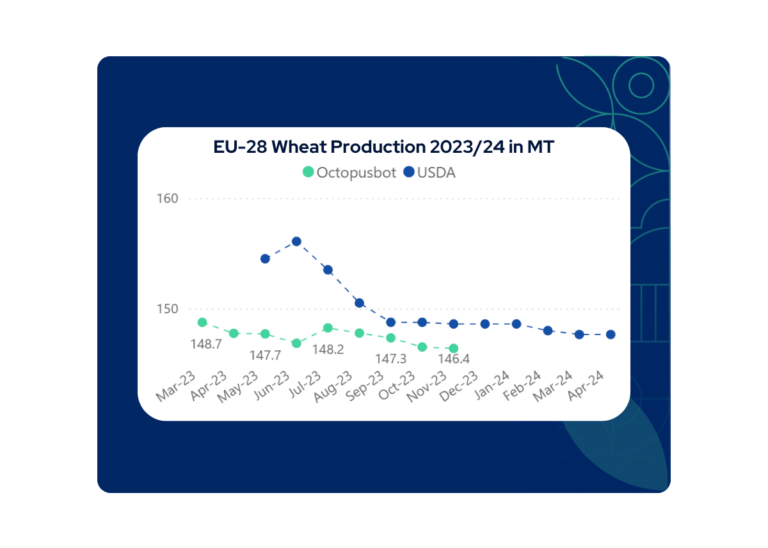
In March 2023, Octopusbot predicted the season’s production for EU-27+UK within 95% accuracy range, 7 months before USDA and 9 months before the final estimate, with a difference of 0.4% on the final estimate.
Octopusbot empowers growers, grain traders, brokers, and agribusinesses globally with trusted forecasts that quantify production risks and shifts early in the season. By removing market noise and bias, Octopusbot’s trusted forecasts help market participants plan ahead with confidence, trade at the right price, make data-driven decisions, and gain an edge to improve income.
 For full, detailed AI forecasts on Europe wheat, corn, barley, rapeseed & more:
Comments are closed