
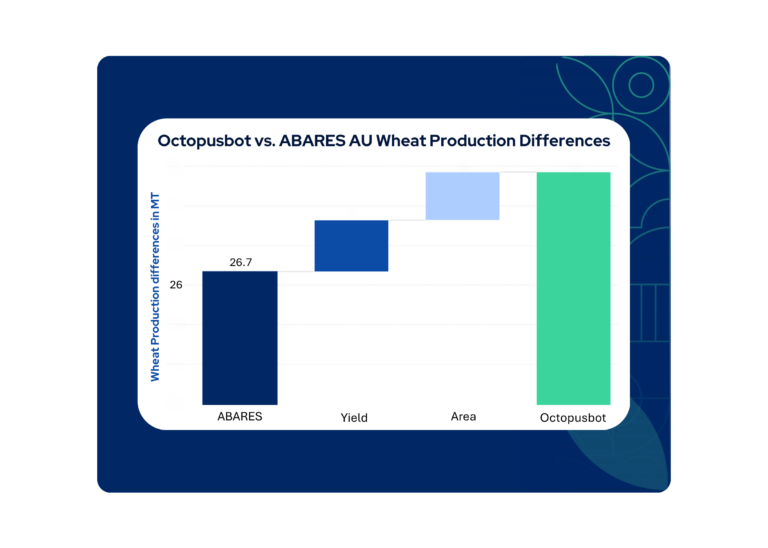
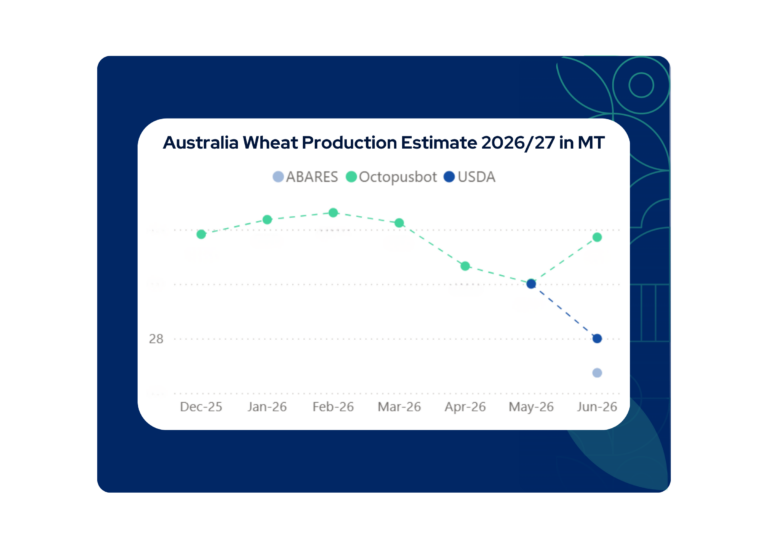
ABARES’ latest release places Australian wheat production for 2026/27 at 26.7MT, a 26% decline versus last season. USDA’s subsequent estimate came in slightly higher at 28MT, but both point to a significantly weaker season.
At 19% above ABARES and 13% above USDA, Octopusbot’s latest production estimate challenges the official outlook, driven by two components: higher planted area estimates across key states, and stronger yields supported by favourable early-season conditions.
This blog examines the key weather and satellite indicators driving Octopusbot’s estimates above official forecasts and quantifies the gap between Octopusbot and official estimates across both planted area and yields at the state level.
What Is Driving the Gap Between Octopusbot and Official Estimates?
Octopusbot’s production estimate sits approximately 19% above ABARES, with the gap explained by two components in roughly equal measure: planted area and yields.
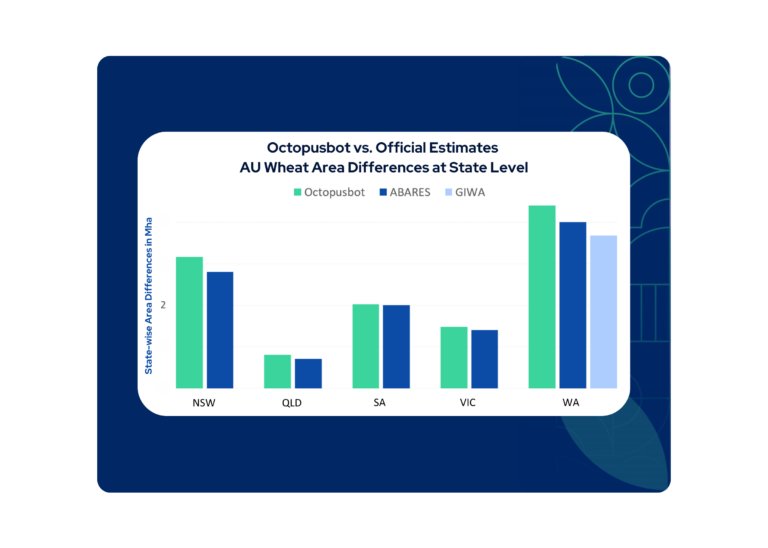
Area accounts for half of this gap, with the most divergence concentrated in NSW and WA. In NSW, Octopusbot has higher area estimates than ABARES, as southern NSW conditions track considerably better than the dry, delayed north, more closely resembling 2023 levels. ABARES’ current estimate does not appear to reflect this regional contrast.
In WA, ABARES and GIWA project year-on-year area declines of 10% and 14% respectively, while Octopusbot’s models point to a smaller decline of around 4%. March and April rainfall was 243% of median, with better emergence versus last year supporting a smaller reduction than official estimates project.
Higher urea prices following the Middle East conflict have pushed growers in Northern NSW and WA toward barley, a less nitrogen-intensive crop, contributing to a national wheat area decline, though not to the extent official estimates project.
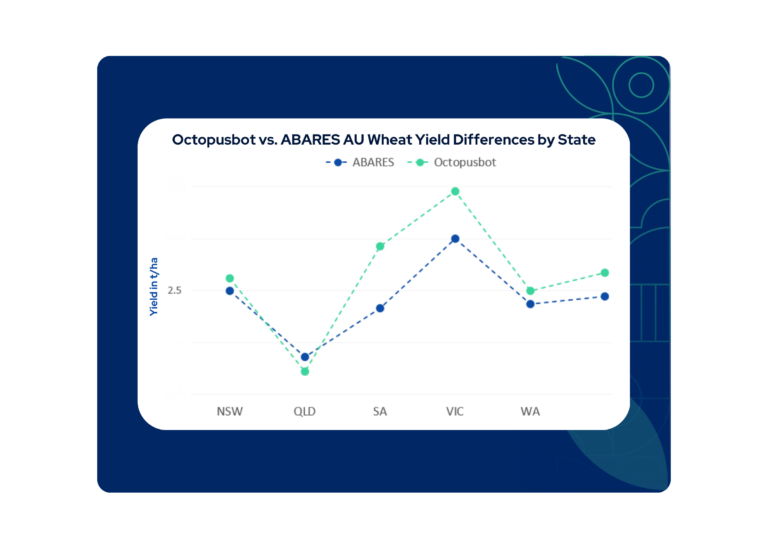
The remaining half of the gap comes from yields. Octopusbot’s yield estimate sits approximately 25% above ABARES in SA, and approximately 15% above in VIC, with seasonal conditions in both states developing more favourably than official estimates reflect.
May rainfall across both SA and VIC was 168% of the median, driving soil moisture to around 109% of median, while above-median seasonal rainfall is forecast from June through October (~120%) across both states.
Octopusbot’s Latest Australia Wheat Production Estimate
Octopusbot’s latest Australian wheat production estimate for the 2026/27 season was revised higher compared with the previous update, supported by above-forecast May rainfall and an improved June rainfall outlook. Even with this upward revision, Octopusbot’s estimate sits 19% above ABARES‘ estimate.
The key drivers impacting the latest production estimate are:
Winter Wheat
- Planted Area: Wheat area is estimated 6.6% lower year-on-year.
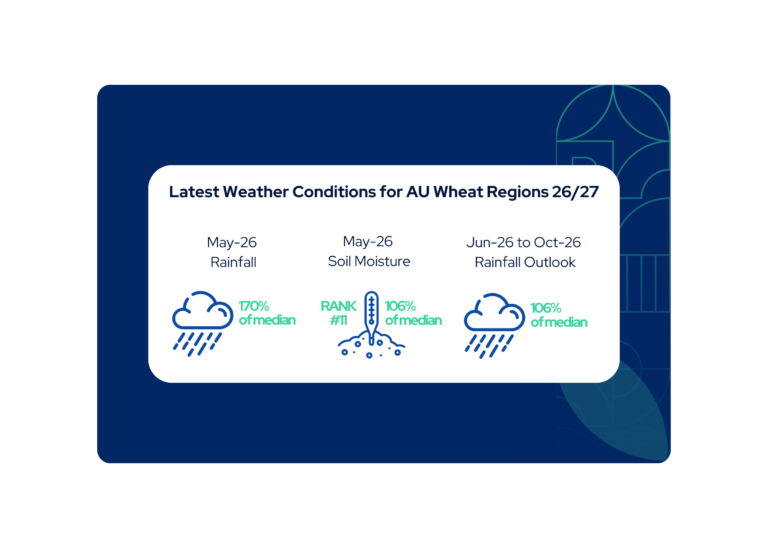
- Precipitation: May 2026 rainfall was above forecast nationally (170% vs. 92% of median forecast).
- Soil Moisture: Above median nationally (106%; rank #11 of the last 27 years).
- Precipitation Outlook: Octopusbot’s Best Accuracy forecast indicates above-median rainfall from June through October (~106% of median).
How Satellite Data Supports Octopusbot’s Higher Estimates
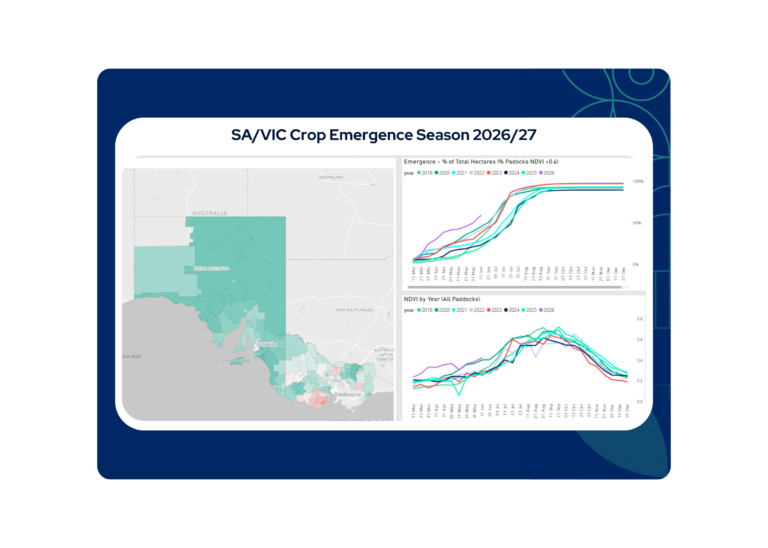
Sentinel-2 satellite crop emergence data provides an important layer of evidence supporting Octopusbot’s higher yield estimates relative to ABARES, largely driven by exceptional early-season crop development in SA and VIC.
SA is recording the highest crop emergence levels in history at 64.5%, with VIC similarly tracking at record levels at 54.0%. The strength of crop establishment across both states confirms that favourable rainfall and soil moisture conditions quantified by Octopusbot’s AI models have translated into strong crop development on the ground, and is a key driver of Octopusbot’s higher yield estimates in both states.
Octopusbot Past Forecast Accuracy
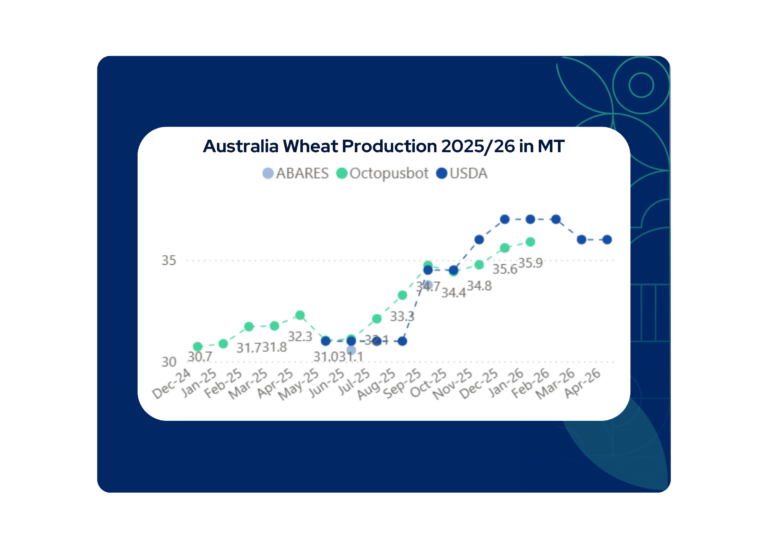
Octopusbot’s models have consistently demonstrated strong forecast accuracy across Australian grain and oilseed markets, combining hundreds of weather parameters with historical yields at the regional level to quantify production shifts early and accurately, well ahead of official estimates.
In September 2025, Octopusbot predicted the season’s production within 95% accuracy range, 6 months before the final estimate and 3 months before ABARES, with a difference of 0.3% on the final estimate.
Octopusbot empowers growers, grain traders, brokers, and agribusinesses globally with trusted forecasts that quantify production risks and shifts early in the season. By removing market noise and bias, Octopusbot’s trusted forecasts help market participants plan ahead with confidence, trade at the right price, make data-driven decisions, and gain an edge to improve income.
 For full, detailed AI forecasts on Australia wheat, barley, canola & more:
Comments are closed