
Octopusbot has raised its latest Australian wheat and barley production estimates, with barley forecast at a record and wheat above both ABARES and USDA. Below-forecast October rainfall in WA and a drier November outlook for the southern harvest supported the latest revisions, while the season’s regional split remains clear, with El Niño’s dry impact concentrated across northern NSW and southern QLD.
At the same time, Australian grain is moving to port at a strong pace. November wheat and barley exports are tracking toward their highest levels on record, while slower December barley bookings and weaker Chinese feed demand point to a more mixed market outlook as harvest progresses.
Latest Australian crop outlook
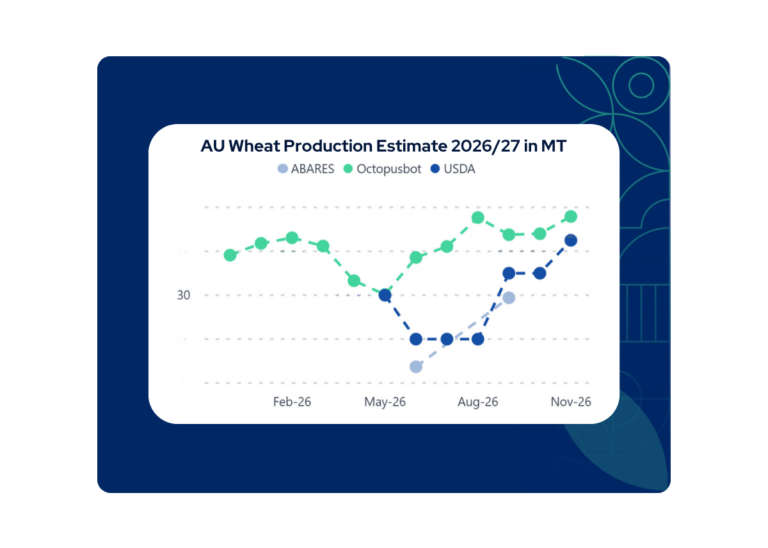
Octopusbot’s latest Australian wheat production estimate was revised 2.4% higher from the previous estimate, mainly driven by yield gains across WA and the southern states. Wheat production is now 12% above ABARES and around 3% above USDA, although still 6% below last year and broadly in line with the 5-year average.
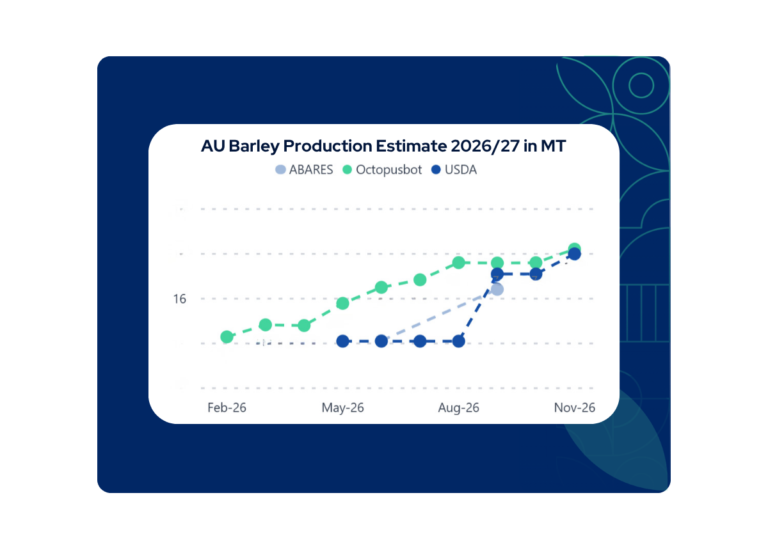
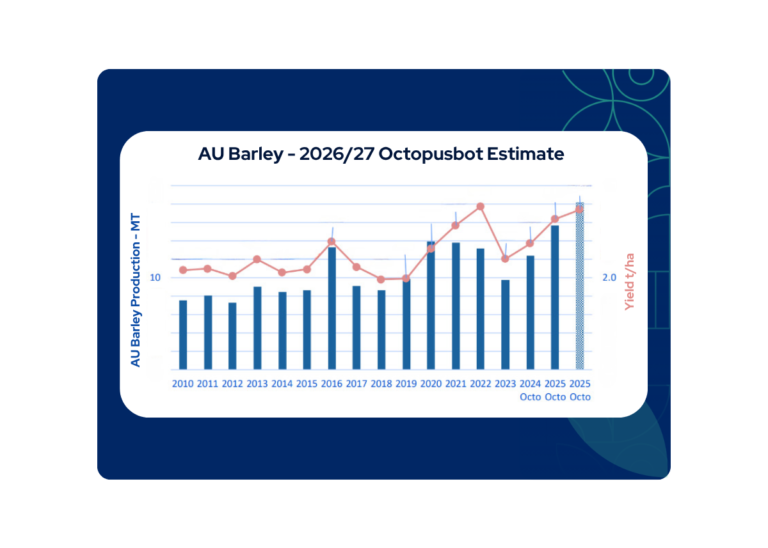
Barley production was revised 3.5% higher from the previous estimate. Production is now 14% above last year and 11.0% above ABARES, while USDA has moved close to Octopusbot’s estimate in its latest release.
Since December 2025, Octopusbot’s Best Accuracy Weather Forecast models, which select the most accurate global forecaster for each region and month, have quantified El Niño’s concentrated dry impact across northern NSW and southern QLD, while southern regions maintained more favourable conditions and WA was largely unaffected. This regional split has persisted through the season, with Wagga Wagga and Mildura recording some of the largest yield gains, while QLD and northern NSW showing the largest reductions compared with last year. As conditions developed in line with this forecast, Octopusbot’s estimates remained above ABARES and USDA since the start of the season, while USDA moved closer to Octopusbot’s estimates.
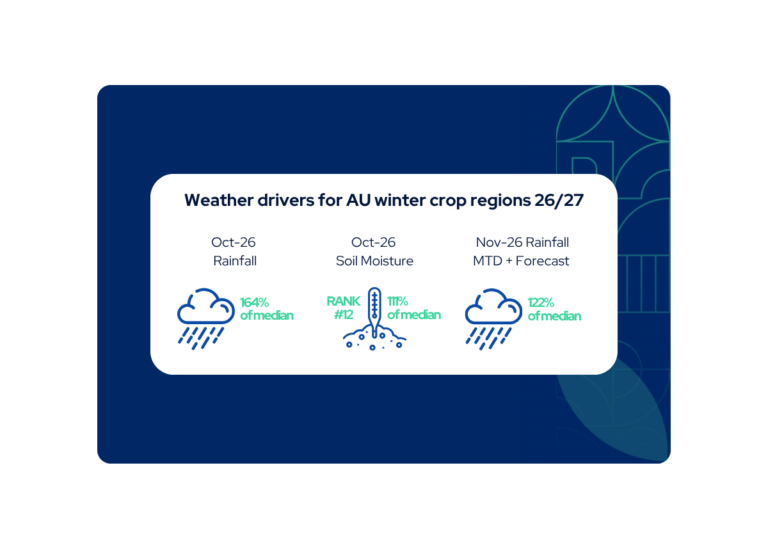
The latest upward revision was supported by October rainfall coming in close to forecast across Australian wheat regions, at 164% of the median against a 163% forecast, while soil moisture remained high at 111% of the median. WA recorded below-forecast October rainfall (104% of the median against a 140% forecast), which favoured harvest, resulting in the largest upward revision this month.
Wheat yields are estimated above both last year and the 5-year average. Higher yields across SA, VIC and southern NSW outweigh reductions across northern NSW, QLD and WA. However, planted area is 8% below last year, keeping national production broadly in line with the 5-year average.
Barley yields are estimated at the second-highest on record, above both last year and the 5-year average. Planted area is also 7% above last year, partly reflecting growers shifting from wheat toward less fertiliser-intensive barley following higher urea prices earlier in the season. The combination of higher planted area and high yields supports Octopusbot’s record barley production forecast.
Mid-harvest update: Southern rains slow harvest
Harvest is running ahead of last year, with 36% of the national crop area harvested by 10 November vs. 32% last year and 92% ripened vs. 84%. WA is well ahead with the crop fully ripened, while NSW is broadly in line with last year. QLD is behind after October rainfall delayed harvest, while SA and VIC are only beginning, although ripening is ahead of last year.
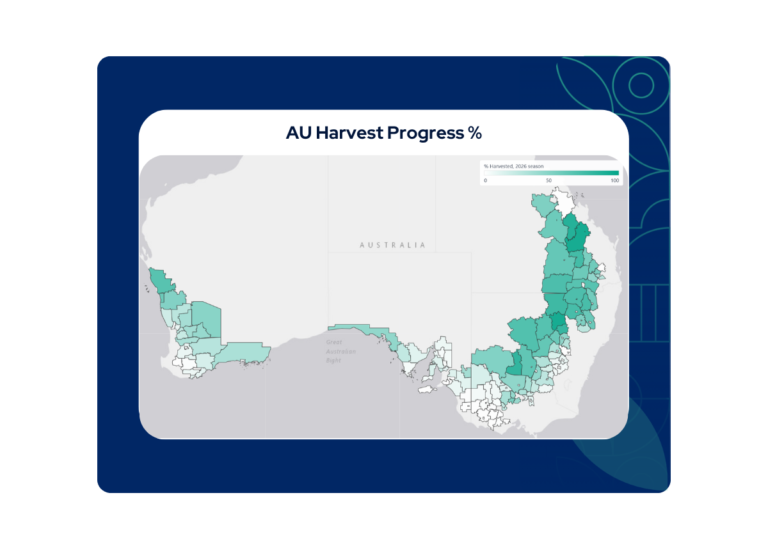
November has brought a mix of dry spells and rainfall. Month-to-date rainfall plus forecast points to below-median totals across VIC, NSW and SA, with national rainfall at 122% of the median, lower than the 143% forecast in the previous month.
Northern regions such as Tenterfield and the Darling Downs received mid-November rainfall, but harvest is already well advanced in these areas. The focus now shifts further south, where short-term forecasts show heavy falls over the coming days across central and southern growing regions, including Nyngan, Dubbo and Wagga Wagga in NSW and Bendigo in VIC. With harvest less advanced across southern regions, these falls are more likely to disrupt progress and could increase grain-quality risk where rainfall persists.
How is export demand tracking for Australian grain?
With a record barley crop and wheat production above ABARES moving through harvest, the focus is shifting to whether export demand can absorb the available supply. Official export data typically lags by two to three months, while Octopusbot’s shipping stems intelligence tracks vessel bookings at Australian grain ports daily and forecasts monthly exports as new bookings come in, providing an earlier view of export demand.
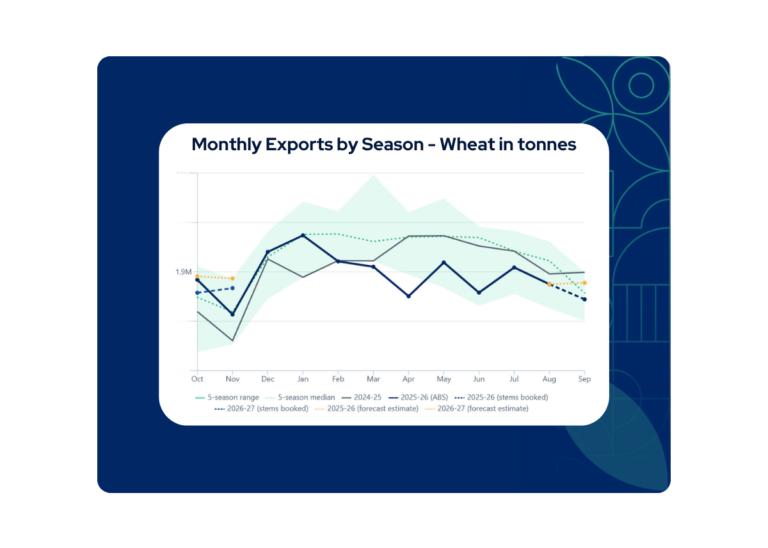
The shipping stems show November wheat exports tracking toward their largest November on record, around 66% above last year and above the top of the 5-season range, with over 90% of forecast tonnes already booked in early November. WA leads early loadings as harvest progresses ahead of last year.
Barley exports are also tracking toward their largest November on record, around 63% above last year’s record November and more than double the 5-season median, with over 86% of tonnes already booked.
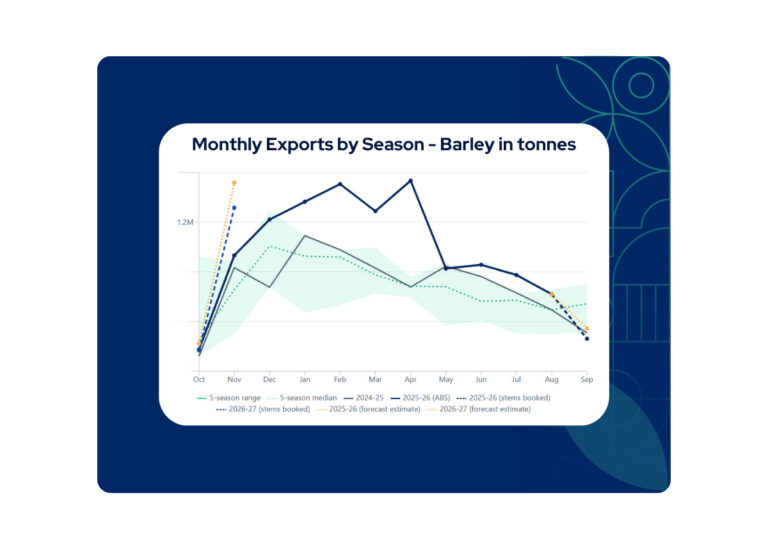
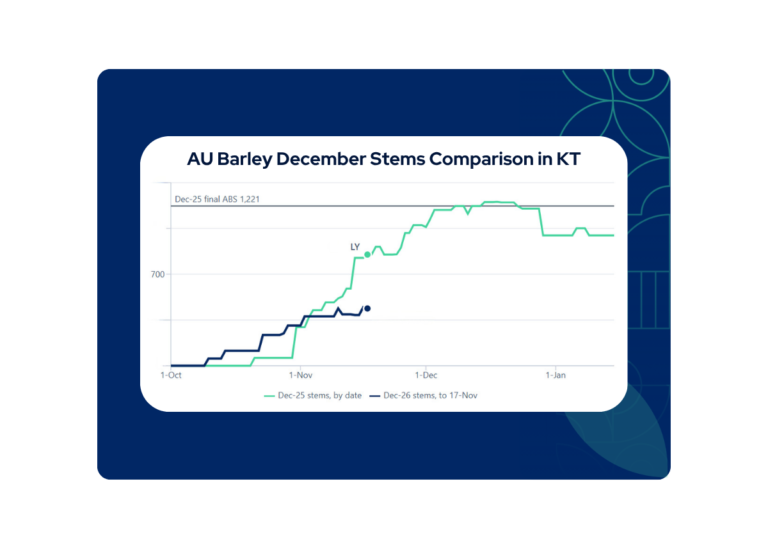
December bookings present a more mixed picture. As of 17 November, wheat stems were in line with the same point last year, while barley stems were 48% lower, with bookings remaining relatively flat since early November. More bookings are expected as the southern harvest reaches port, making December barley stems an important indicator of whether export demand is keeping pace with the record crop.
What does this mean for Australian grain markets?
Barley faces the greater demand risk. China accounted for 80% of Australian barley exports last season, but Chinese imports are expected at 9MT this season compared with 14MT last year. A large domestic corn crop, damaged domestic wheat crop used as feed and a smaller pig herd are reducing Chinese feed grain demand.
Combined with Australia’s record barley crop and slower December bookings, lower Chinese demand creates a more bearish outlook for Australian barley prices.
For wheat, record November bookings show strong early export demand, although the broader outlook remains more balanced. China is expected to import 7MT this season and has already purchased 120KT from France, increasing competition for Australian wheat. Black Sea export flows, importer stocks and Chinese demand will also influence Australian wheat prices through the season.
Octopusbot past forecast accuracy
Octopusbot’s models have consistently demonstrated strong forecast accuracy across Australian grain and oilseed markets, combining hundreds of weather parameters with historical yields at the regional level to quantify production shifts early and accurately, well ahead of official estimates.
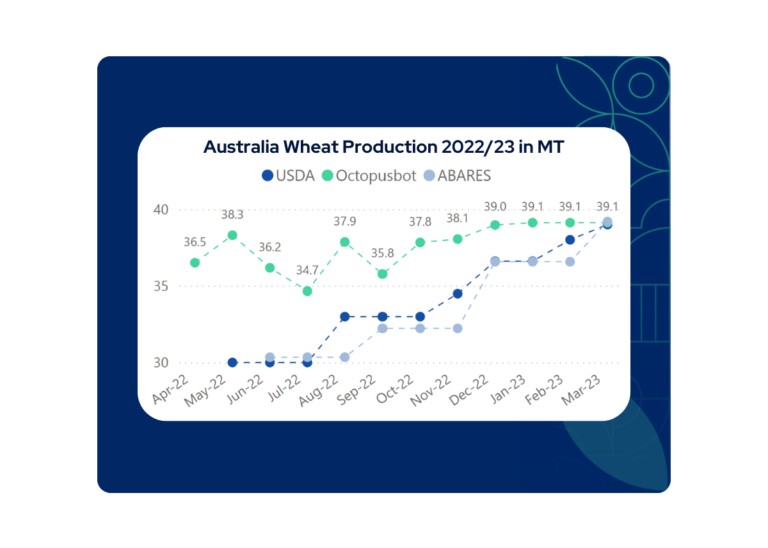
In May 2022, Octopusbot predicted the season’s production for Australia wheat within 95% accuracy range, 10 months before the final estimate, 9 months before USDA and 10 months before ABARES, with a difference of 0.3% on the final estimate.
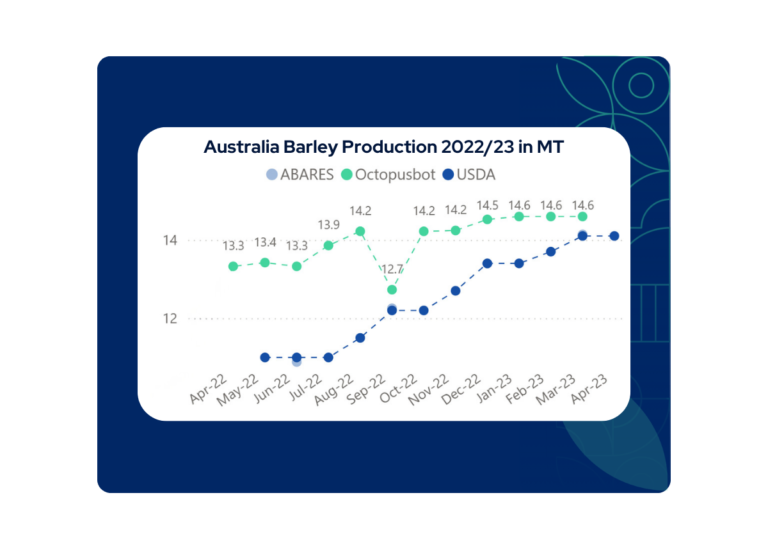
In April 2022, Octopusbot predicted the season’s production for Australia barley within 95% accuracy range, 10 months before the final estimate and 7 months before USDA and ABARES, with a difference of 3.5% on the final estimate.
Octopusbot empowers growers, grain traders, brokers, and agribusinesses globally with trusted forecasts that quantify production risks and shifts early in the season. By removing market noise and bias, Octopusbot’s trusted forecasts help market participants plan ahead with confidence, trade at the right price, make data-driven decisions, and gain an edge to improve income.
 For full, detailed AI forecasts on Australia wheat, barley, canola & more:
Comments are closed